
Find what’s really in the way, then clear it.
Every goal has a handful of things holding it back right now. Clearahead helps your team find the real causes rather than the symptoms, agree which to tackle first and work on them together, with AJ asking the questions a good adviser would.
Free for up to 3 people. No card needed.

Busy is not the same as moving.
Most teams are working hard on plenty of things, and many of them are symptoms: the pipeline is thin, onboarding is slow, churn has crept up. Fix a symptom and it comes back next quarter, because the cause underneath it hasn’t changed.
The fastest-moving companies work the other way round; they find the one or two things genuinely in the way of the goal, clear them, and then look again. That’s the cadence Clearahead is built around: set the direction, find what’s in the way and remove it.
How Clearahead does it.
Name the constraint, not the symptom.
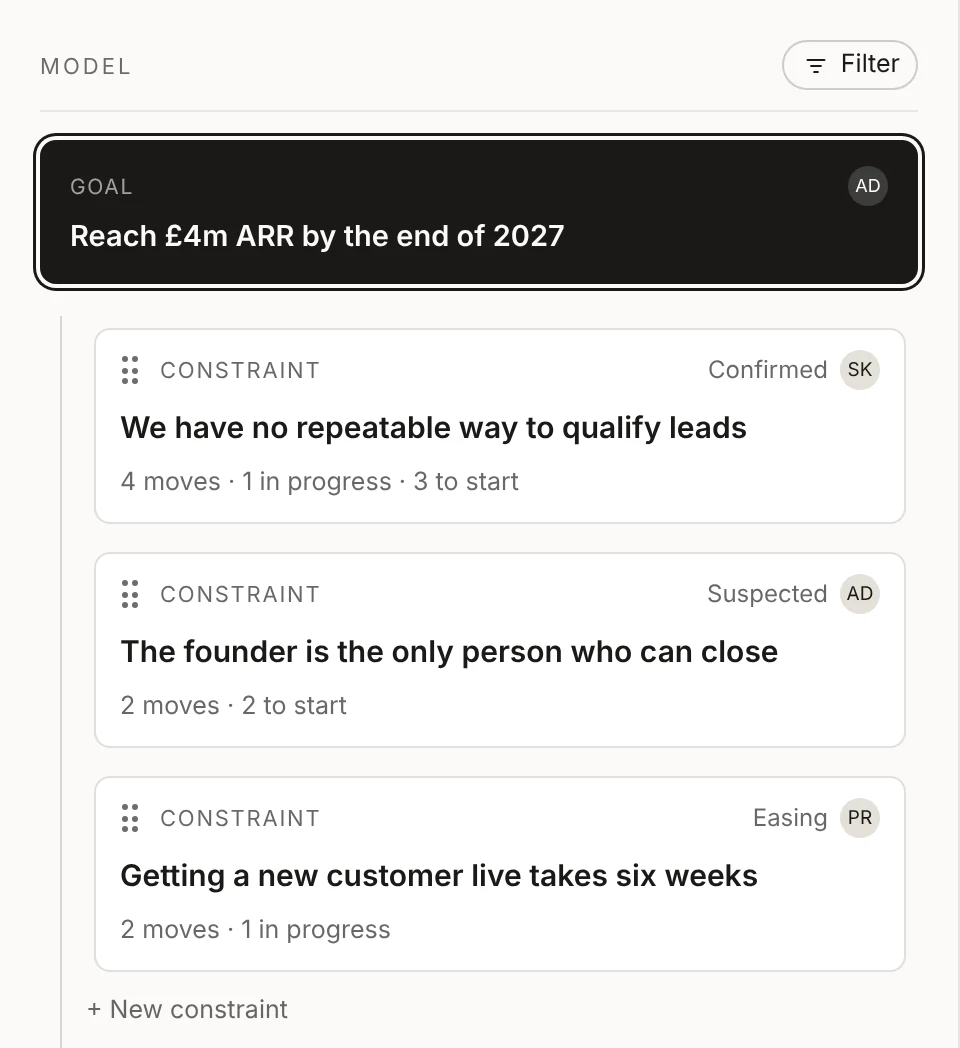
Describe what you’re seeing and AJ asks “why?” until you reach something you can actually fix. That becomes a constraint: a cause holding the goal back right now, written up with why it matters, why you believe it and how you’ll know it’s cleared.
Most goals have three to five at a time, kept one level deep on purpose, so symptoms are saved as evidence on a constraint rather than piling up as more work.
Tell a hunch from a fact.
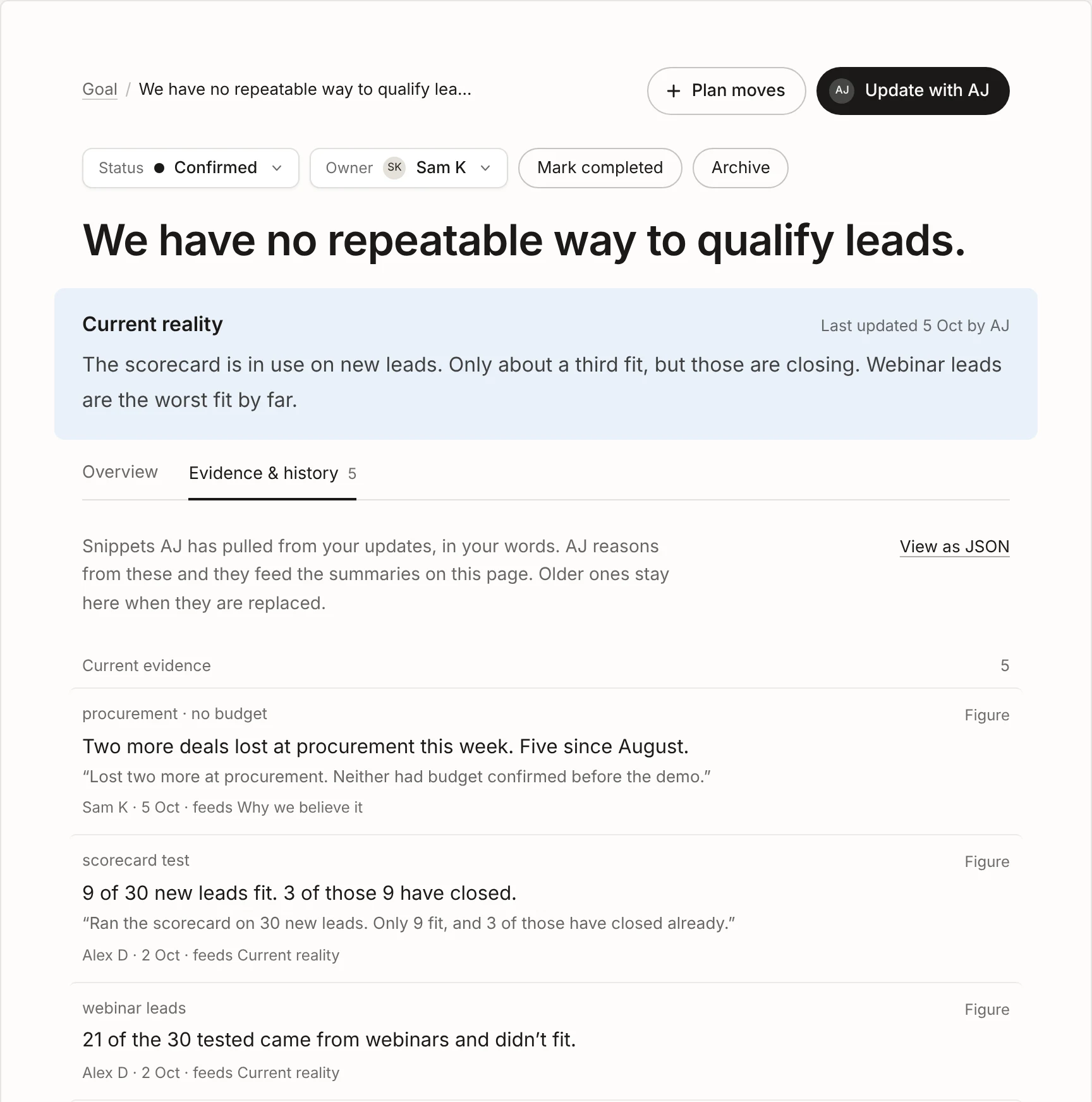
Each constraint has a status, from suspected to confirmed to easing, and every update adds evidence: figures, observations, estimates and beliefs, with how sure the person was. Nothing is treated as known until the team has seen it.
Drag the constraints into the order you’ll tackle them, so everyone can see what comes first and why.
Plan the moves that clear it.
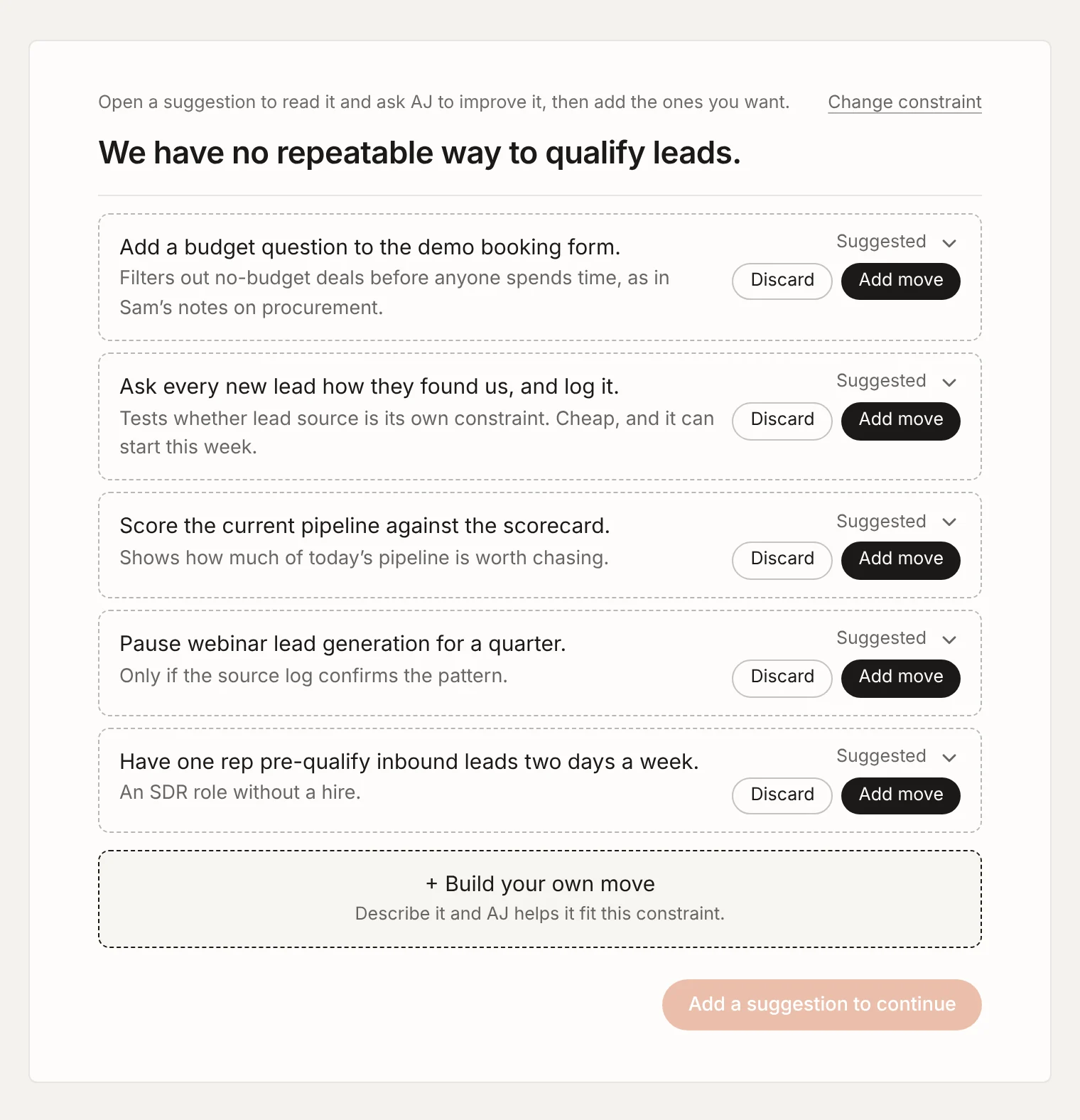
Click Plan next moves and AJ suggests moves for the constraint, in the order to tackle them, with its reasoning for each. Keep the ones you like or build your own, and give each one an owner and a due date, so the work stays small, specific and done in weeks rather than quarters.
Know when it’s cleared.
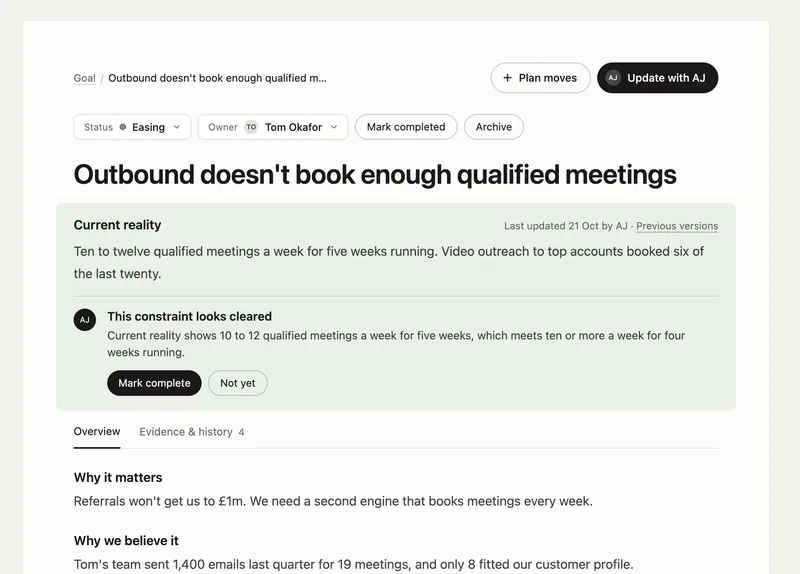
As moves land and the team reports back, AJ rewrites the current reality and says when a constraint looks cleared, measured against how you said you’d know. You decide whether it’s right; then it moves to Completed, and AJ remembers how you cleared it in case something similar turns up.
What changes.
-
Fewer, better priorities.
Three to five constraints, in order, instead of a long list of initiatives.
-
Causes, not symptoms.
AJ keeps asking why until you reach something you can fix.
-
Decisions backed by evidence.
Every constraint shows what the team has seen and how sure they are.
-
Learning that compounds.
AJ remembers how each constraint was cleared and brings it up when it’s useful.
The parts of the app that do it.
- The model Your goal, what’s holding it back and the moves to clear it, in one view.
- Evidence The facts behind every item, saved from each update with who said it and when.
- Context area Every goal, constraint and move in detail, with where it stands and why.
- Ideas Somewhere to keep ideas beside the model until someone starts one.
Further reading How the theory of constraints built Clearahead →Remove constraints, don’t add initiatives →First principles thinking in business →
Questions.
What is a constraint?
A constraint is a cause holding your goal back right now, as opposed to a symptom you can see. The idea comes from the theory of constraints: improve the one thing limiting the whole system and everything downstream moves. Read how it shaped Clearahead.
How many constraints should we work on at once?
Most goals have three to five at any one time. If you have many more, some are probably symptoms of the same cause, and AJ will help you find it.
Does AJ decide for us?
No. AJ asks questions, suggests moves and flags when something looks cleared, but your team decides. AJ’s view is a guide, never a gate.
What if we’re not sure what’s in the way?
That’s the usual starting point. Try the free goal writing tool: write a goal with AJ and find what’s holding it back, with no account needed.
What else Clearahead does.



What’s in your way?
Free for up to 3 people. No card needed.