
An AI adoption plan that changes how the company runs, not just its tools.
Most AI programmes start with licences and pilots, and end with pockets of productivity nobody can add up. Clearahead treats AI adoption like any other company goal: a clear outcome, an honest view of what’s in the way and the moves to clear it, with an owner on every one. AJ, the AI inside Clearahead, keeps it current, so the board sees progress on the business, not a count of seats.
Free for up to 3 people. No card needed. Or speak to us.
What is an AI adoption plan?
An AI adoption plan sets out how a company will use AI to change the way it works, and what that should achieve. It covers where AI will make the biggest difference, which tools and policies the company needs, how people will learn to use them, how data will be handled, and how the company will know it’s working. Some companies call it an AI transformation plan or an AI strategy; the job is the same.
Companies tend to move through three stages. AI-assisted: you’ve decided to adopt AI and you’re working out how. AI-enabled: your team uses AI daily, but how the company runs hasn’t changed. AI-native: you’ve rebuilt the work around AI and the operating rhythm matches. A good plan is clear about which stage you’re at and what the next one looks like for your business.
Why AI adoption needs a plan, and who owns it.
AI changes how fast work can happen. The companies that benefit most aren’t the ones with the most tools; they’re the ones that change what they do with the time and insight AI gives them. Without a plan, adoption is patchy: some teams race ahead, some ignore it, and the gains don’t show up in anything the board measures.
Ownership varies. Sometimes the CEO leads it personally. Often a COO, chief technology officer or a new head of AI owns the programme, with champions in each department. Increasingly, boards and investors are asking for an AI plan, which puts the leadership team on the hook for results rather than activity.
The biggest shift isn’t in the tools. It’s that the company still runs on monthly reports, status meetings and a plan from January, while the work underneath moves daily. An AI adoption plan that doesn’t change how the company sets priorities and tracks progress leaves most of the value on the table. That’s the case we make in The operating model for the AI era, and why we built Clearahead for companies implementing AI.
What makes AI adoption hard.
The technology is rarely the problem. The organisation around it usually is.
-
Pilots everywhere, no shared goal.
Every team is experimenting. Nobody can say how the experiments add up to what the company is trying to achieve.
-
Measuring usage, not outcomes.
Licences issued and prompts written are easy to count. They don’t tell the board whether the business is better.
-
People are unsure or worried.
Some fear for their jobs, some don’t know what’s allowed. Without clear direction, many quietly opt out.
-
Policy and data questions stall it.
What can go into which tool? Until someone answers, cautious teams wait and bold ones take risks.
-
The way the company runs stays the same.
Work speeds up, but reporting is still monthly and priorities are still set once a year. The gains leak away.
How to run an AI adoption plan in Clearahead.
Start with the outcome, not the tools. Give AI adoption its own workspace with a goal the board would care about: “Cut the time from enquiry to proposal from five days to one by Q3, using AI across sales and delivery”, or “Every department running its weekly work through AI by the end of the year, with no rise in headcount”. Write why it matters and how you’ll know.
With AJ, work out what’s really in the way. AJ asks the questions a good transformation lead would: where does the time go today, what’s stopping teams using AI there, what would have to be true. You’ll find constraints like “Nobody knows what data they’re allowed to use with AI”, “Proposals depend on one person’s templates” or “Managers don’t know what good AI use looks like”. Put them in order and give each an owner, so adoption becomes the leadership team’s work rather than one champion’s.
Then let Clearahead do what it does for every goal. People update AJ in a sentence, AJ keeps the evidence and This week from AJ shows the leadership team progress every Monday. And because AJ is an AI doing the admin of running the company, the plan itself changes how you run: no status meetings, no monthly pack, a model of the company that stays current. That’s often the most persuasive part of an AI programme. Read The machine asks, people decide for how we think about where AI should and shouldn’t make the calls.
- 01
Set an outcome, not a tool target.
Talk AJ through what AI should change for the business. Agree a goal the board would recognise.
- 02
Find what’s stopping adoption.
AJ helps you find the constraints, from data policy to skills to process, and puts them in order.
- 03
Give each department an owner.
Heads of department own moves in their area, so adoption isn’t left to one champion.
- 04
Run the company the AI way.
Updates in a sentence, a weekly brief from AJ and no status meeting. The plan itself is the change.
- Nobody knows what client data they’re allowed to use with AI
- Proposals depend on one person’s templates and judgement
- Managers don’t know what good AI use looks like in their team
- Write a one-page data policy for AI tools and share it with every team
- Agree which AI tools are approved for client work
- Run a 30-minute walkthrough for each department on the policy
An illustration, not a customer story.
What it looks like in Clearahead.
Real screens from the app. AJ keeps them up to date as your team works.
-
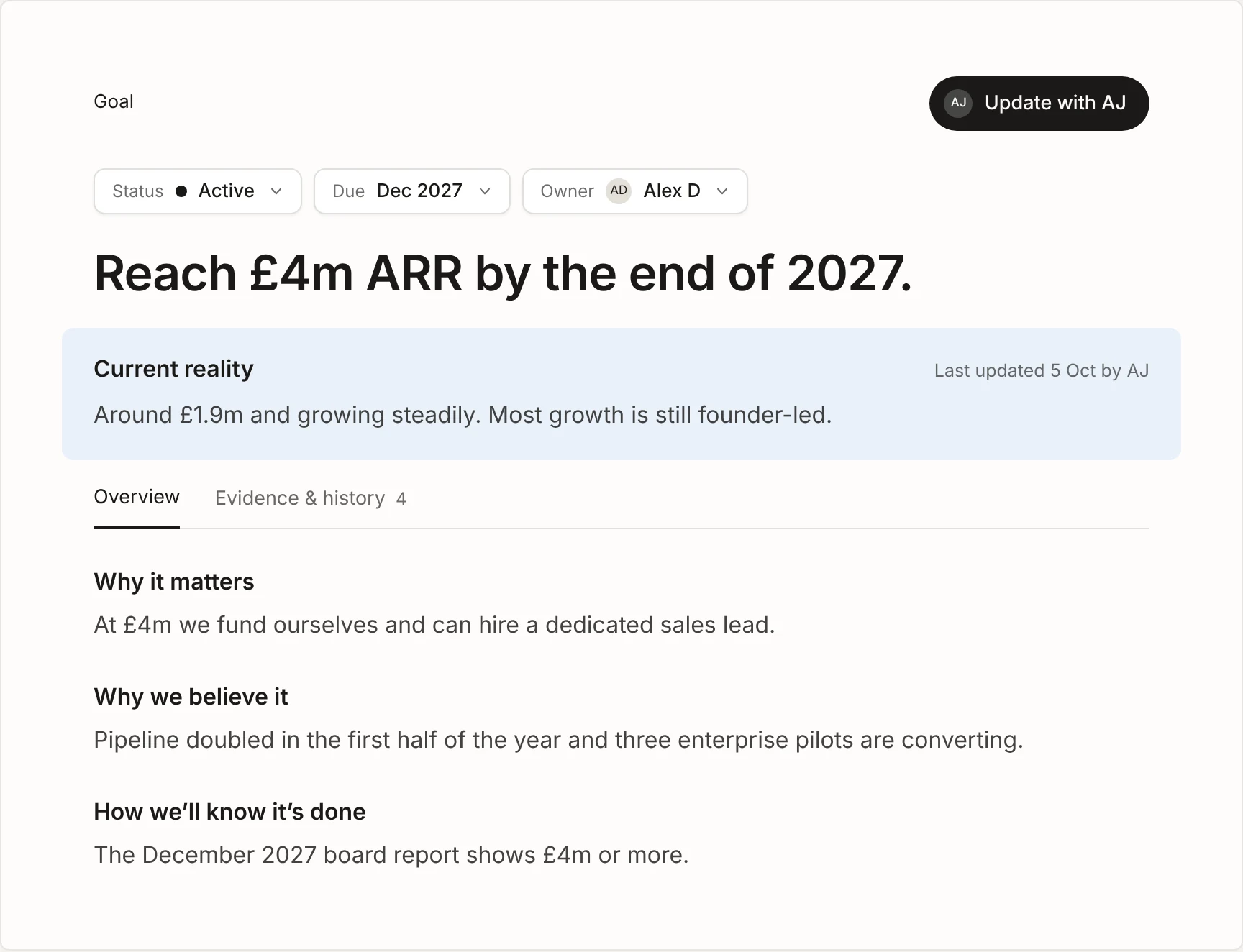
The goal, on one page.
What you’re aiming for, why it matters, how you’ll know it’s done and where it stands today, in your team’s words.
-
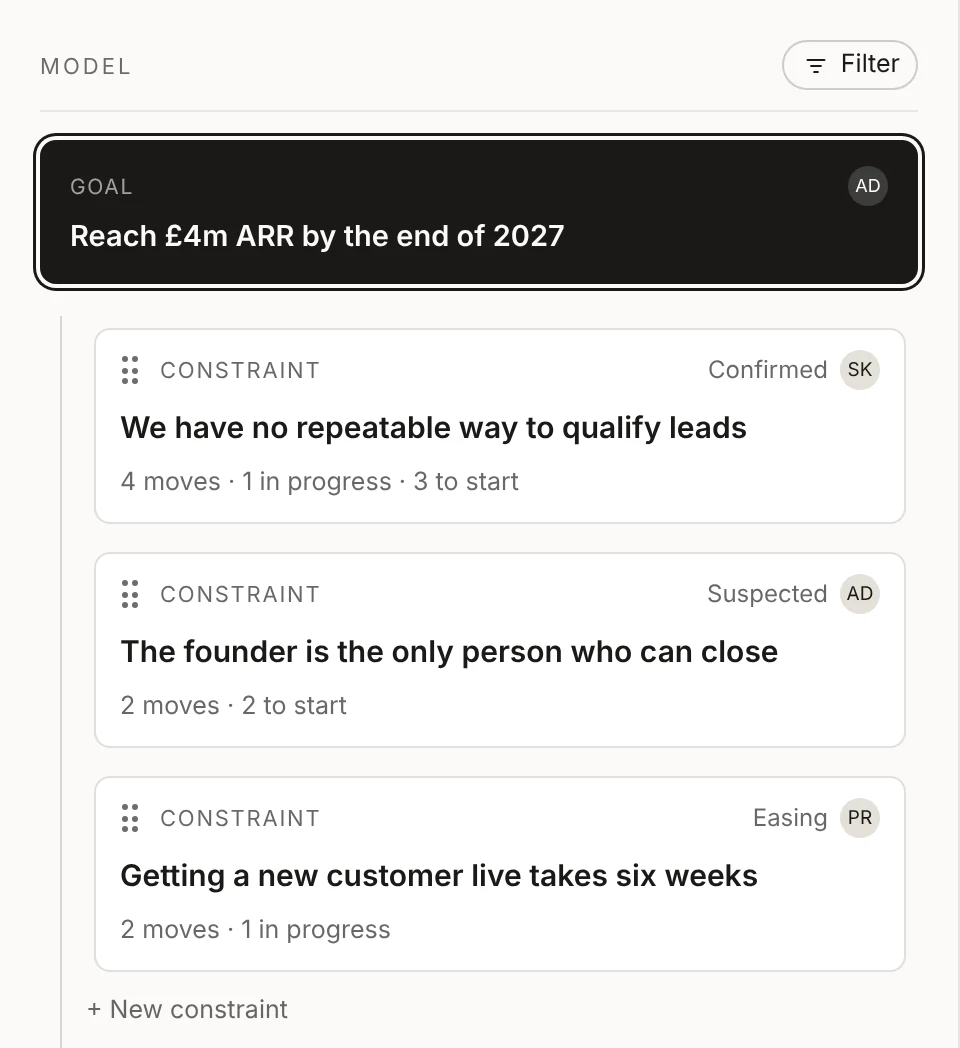
What’s holding it back, in order.
The few constraints really in the way, each with an owner and a status. Your team decides the order.
-
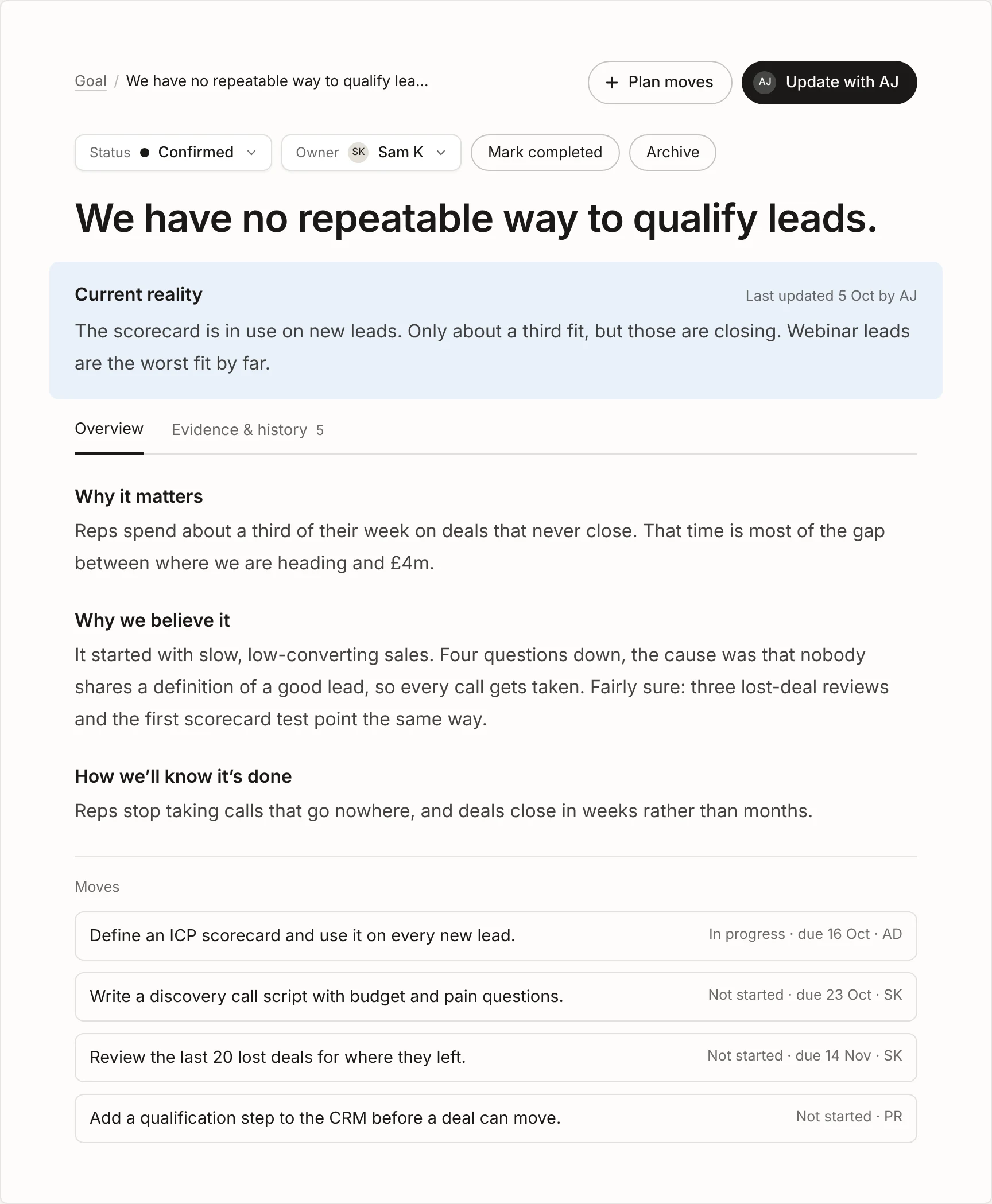
The moves, each with an owner.
Every move has a status, a due date and one person. They update AJ in a sentence when it moves.
-
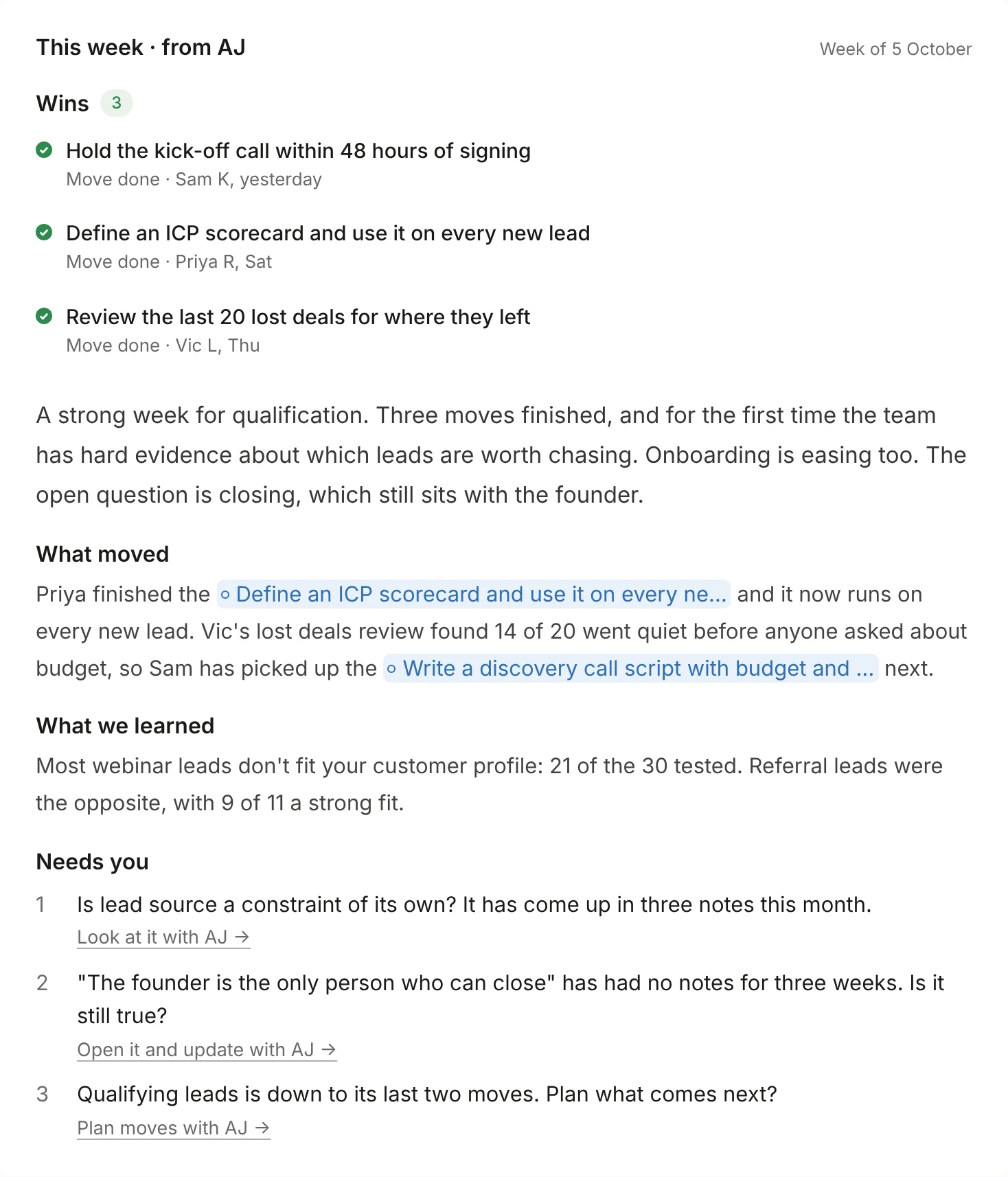
This week from AJ.
The wins, how it’s going and up to three things that need a decision, ready every Monday.
AI adoption works best tied to a business goal.
AI adoption on its own can drift into a technology project. It works best next to the goals it’s meant to serve. The same leadership team might use AI to improve margins, to scale without adding headcount, or to grow revenue faster than the team grows.
In Clearahead each goal has its own workspace, up to 10 on the Clearahead plan, with people and billing shared across the organisation. A move like “Use AI to draft first proposals” can sit in the AI workspace while the effect shows up as evidence in the revenue or profit workspace. Heads of department see their AI moves alongside the rest of their work in My work, so adoption becomes part of the day job rather than an extra.
If you’re comparing Clearahead with using a general AI assistant to run your plans, see ChatGPT and Claude vs Clearahead. For a fuller picture of companies moving to AI, see Clearahead for companies implementing AI.
- Often run alongside Scaling a company Grow from a founding team to a company that runs without the founder in every decision.
- Often run alongside Profit improvement planning Raise margins and profit without losing the momentum that got you here.
- Often run alongside Revenue growth planning Find what’s really capping revenue and get the whole team moving on it.
- Often run alongside Customer retention planning Find why customers leave and get every team working on keeping them.
Who does what.
Three roles, enforced by the app. Everyone is included in one price.
-
CEO, COO or head of AI
ArchitectSets the AI goal, agrees what’s in the way and makes the calls AJ says need them.
-
Heads of department and AI champions
ContributorOwn the moves in their area, share what works and update AJ in a sentence.
-
Board, investors and advisers
ViewerSee real progress on the AI plan and ask AJ questions, without waiting for a report.
One price for every goal you run.
Free
£0
Up to 3 people and one workspace, with full access to AJ. No card needed.
Clearahead plan
£297 a month
Or £2,997 a year. Unlimited people and up to 10 workspaces, one for each goal. No seats to count.
Questions.
What should an AI adoption plan include?
A clear business outcome, the constraints in the way, such as data policy, skills and process, the moves to clear them and an owner for each. Clearahead holds all of that in one place, kept current by AJ.
Is Clearahead an AI tool?
Yes. AJ, the AI inside Clearahead, does the asking and the admin: it helps you find constraints, keeps the plan current from short updates and writes a weekly brief. Your team makes every decision.
Does our company need to be AI-native already?
No. Clearahead suits companies at any stage, from deciding to adopt AI to rebuilding around it. It isn’t a fit if you have no plans to use AI at all.
Is our data used to train AI models?
No. AJ uses OpenAI’s API, and your data isn’t used to train their models. Everything is encrypted and held in European data centres. Read our privacy policy.
Can an AI implementation partner use it with us?
Yes. Invite them as Viewers or Contributors at no extra cost. Partners working with several clients can switch between organisations from one login. See Clearahead for advisers.
Can we run this alongside our other goals?
Yes. Each goal gets its own workspace with its own constraints, moves and weekly brief. The free plan has one workspace and the Clearahead plan includes up to 10, with your people and billing shared across them. See every use case.
How much does Clearahead cost?
Free for up to three people and one workspace, with full access to AJ and no card. Then £297 a month or £2,997 a year ($397 or $3,997) for the whole company, with unlimited people and up to 10 workspaces. See pricing.
Still have a question? Get in touch.
More ways teams use Clearahead.
- GTM planning tool Go-to-market planning
- Product launch planning tool Product launch planning
- Acquisition planning tool Acquisition planning
- Fundraising planning tool Fundraising planning
- Market expansion planning tool Market expansion planning
All use cases → Who Clearahead is for → Goal tracking software →
Change how the company runs, not just its tools.
Free for up to 3 people. No card needed.