
The product launch planning tool for teams bringing something new to market.
A launch has a date, a dozen moving parts and people from every team who all need the same picture. Clearahead gives the launch one goal, an honest list of what could stop it landing, and the moves to clear each risk, with an owner on every one. AJ, the AI inside Clearahead, keeps it current from short updates, so you see a slipping launch weeks before launch day, not the week of it.
Free for up to 3 people. No card needed. Or speak to us.
What is product launch planning?
Product launch planning is the work of bringing a new product, feature or offer to market: deciding what “launched” means, getting the product ready, getting the market ready and getting the company ready to sell and support it. It covers the product itself, the positioning and pricing, the launch content and channels, sales enablement, customer onboarding and support, and the measures that will tell you whether the launch worked.
It differs from go-to-market planning in its shape. A GTM plan is about winning a market over months or years. A launch is a concentrated push with a date, where many teams have to be ready at the same moment. The two usually run together: the launch is how the product arrives, and the go-to-market is how it keeps winning afterwards.
Why the launch matters, and who owns it.
You only get one first impression. A launch that lands with a clear story, a working product and a sales team that can explain it builds momentum that’s hard to buy later. A launch that slips, or goes out half-ready, costs more than the delay: early customers churn, reviewers move on, and the team spends the next quarter recovering instead of building.
Ownership is often blurry. A product manager or head of product usually drives the build. Marketing owns the announcement. Sales owns the first deals, and customer success owns the first experience. In a startup the founder holds all of it. In a growing company a COO or launch lead is supposed to tie it together, but they own almost none of the work themselves.
That’s why launches are a leadership team job. The question isn’t whether each team has a plan; they always do. It’s whether the leadership team can see, at any moment, which part of the launch is really at risk and what’s being done about it. Getting everyone to see the same picture of the launch is what turns a list of team plans into one launch.
What makes launching a product hard.
Launches rarely fail for want of effort. They fail because the risk that matters is hidden among a hundred tasks that don’t.
-
A launch plan is mostly tasks.
Hundreds of checklist items, all looking equally important. The two that will really decide the launch are buried in the middle.
-
Each team reports green until it’s red.
Product says the build is on track, marketing says the content is ready. Nobody says the pricing still hasn’t been agreed.
-
Dependencies hide between teams.
Sales can’t be trained until the demo works. The demo can’t work until the integration ships. Nobody owns the gap.
-
The launch date drives every decision.
Scope gets cut quietly to hit the date, and the market gets something different from what was promised.
-
Learning stops on launch day.
The plan ends at the announcement. What happens in the first 60 days, when the real lessons arrive, isn’t planned at all.
How to plan a product launch in Clearahead.
In Clearahead your launch gets its own workspace with one goal, written so you’ll know when it’s done. Not “launch v2”, but something like “Launch the payments add-on to existing customers by March, with 50 accounts live in the first 60 days”. That definition matters because it carries the launch past the announcement into the part that counts.
Under the goal you don’t list every task. You list the constraints: the few things that would stop the launch landing if nobody dealt with them. “We haven’t agreed the price.” “Support can’t handle a new product without a playbook.” “The integration depends on a partner who hasn’t committed a date.” AJ helps you find them by asking the questions a launch lead would, then helps you put them in order. Keep your task lists in Jira, Asana or Linear; Clearahead tracks the risks those tasks are meant to clear.
Each constraint gets a few moves with an owner and a date. As the launch gets closer, people tell AJ what happened in a sentence. AJ updates the model, keeps the facts as evidence, and flags anything that’s gone quiet. Every Monday, This week from AJ tells the leadership team what moved and the decisions they need to make. When a constraint clears, AJ suggests what to tackle next, including the post-launch work most plans forget.
- 01
Define what “launched” means.
Talk AJ through the product and the market. Agree a goal with a date and a measure that goes beyond the announcement.
- 02
Name the launch risks.
AJ helps you find the few constraints that could stop the launch landing, from pricing to support, and puts them in order.
- 03
Give every risk an owner.
Product, marketing, sales and support each own moves. Everyone sees how their work fits the launch.
- 04
Run through launch and beyond.
Updates take a sentence. AJ keeps the picture current through launch day and the first months after it.
- We haven’t agreed the price or how it’s packaged
- Support has no playbook for payment issues
- The bank integration depends on a partner date we don’t control
- Test two price points with ten existing customers
- Agree packaging with sales and finance in one session
- Write the pricing page and the sales one-pager from the decision
An illustration, not a customer story.
What it looks like in Clearahead.
Real screens from the app. AJ keeps them up to date as your team works.
-
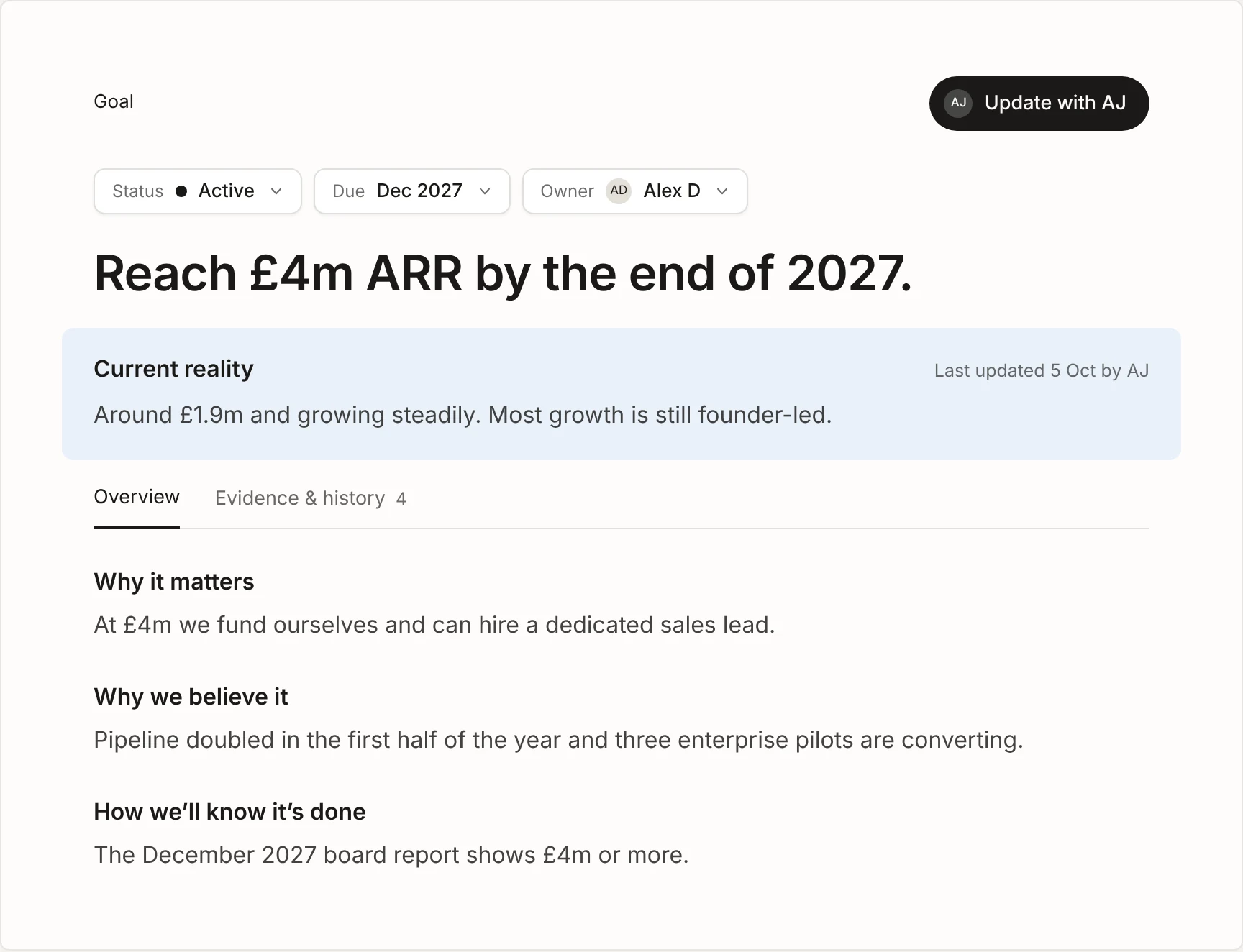
The goal, on one page.
What you’re aiming for, why it matters, how you’ll know it’s done and where it stands today, in your team’s words.
-
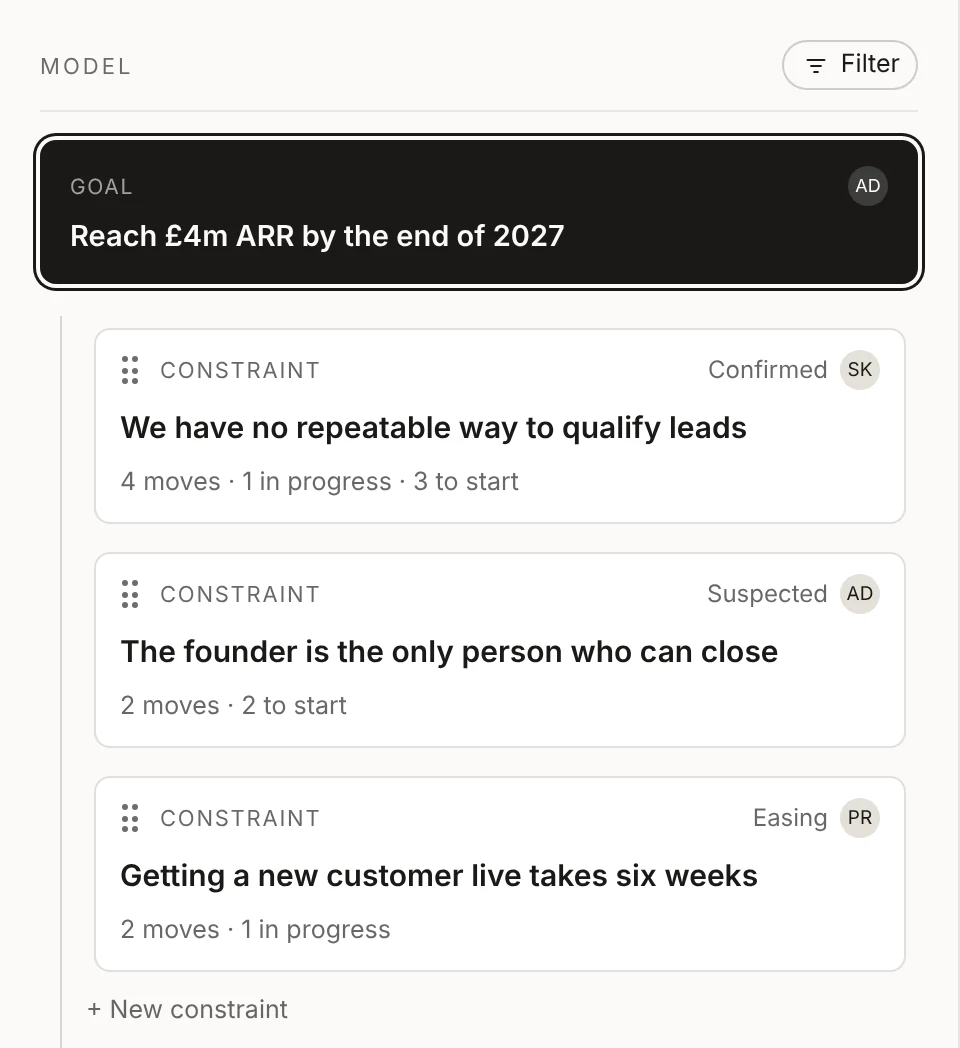
What’s holding it back, in order.
The few constraints really in the way, each with an owner and a status. Your team decides the order.
-
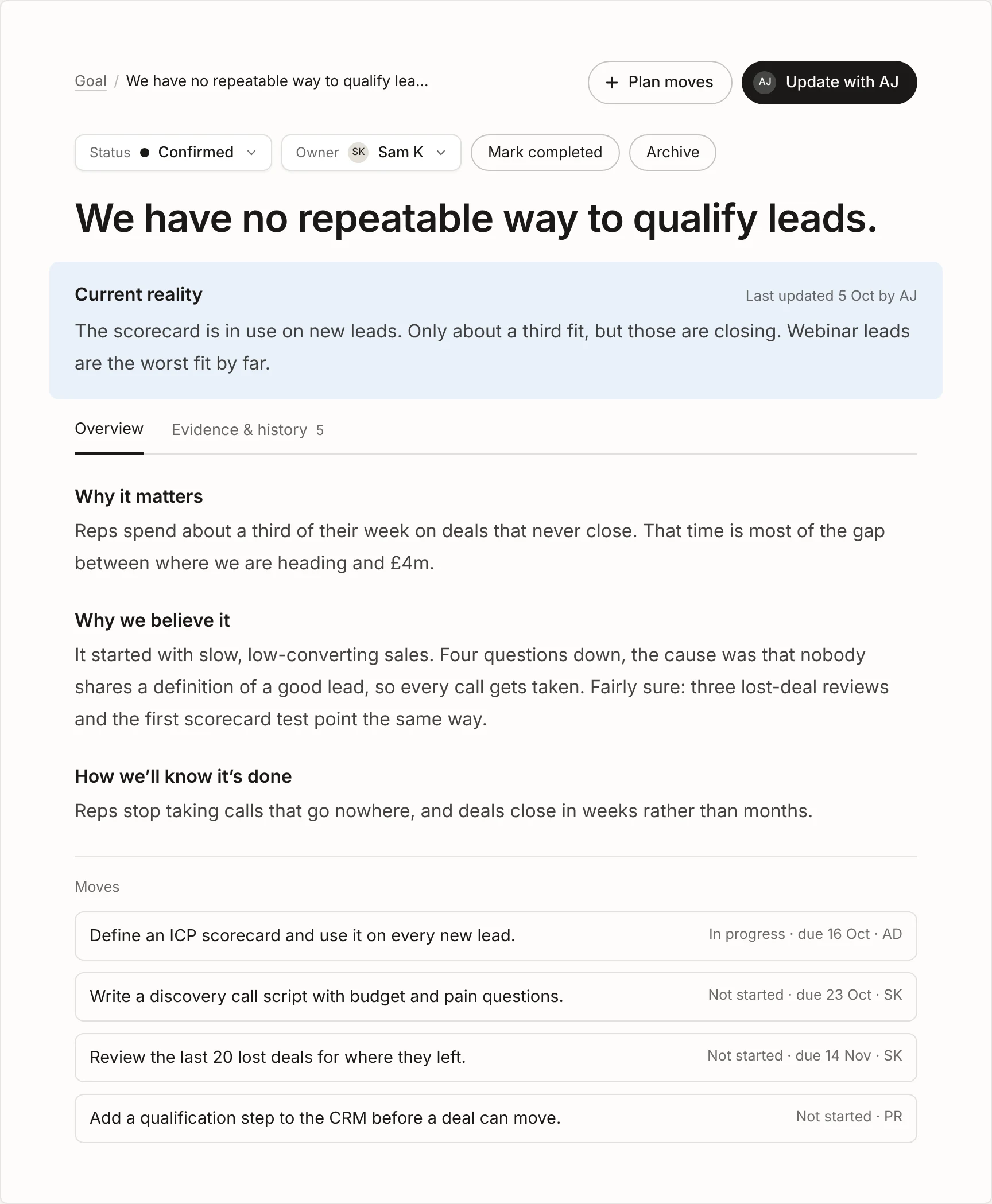
The moves, each with an owner.
Every move has a status, a due date and one person. They update AJ in a sentence when it moves.
-
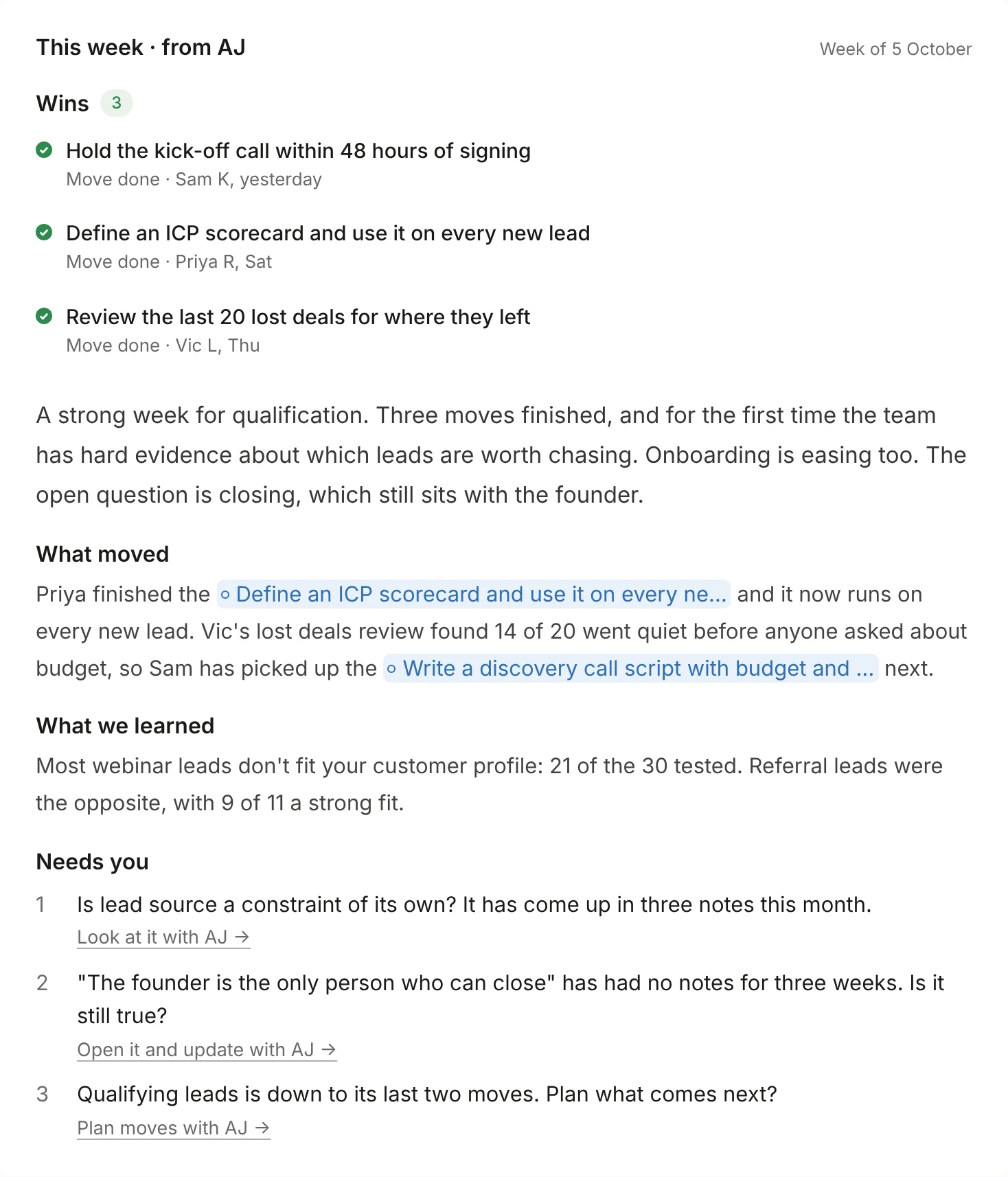
This week from AJ.
The wins, how it’s going and up to three things that need a decision, ready every Monday.
Launch while the rest of the company keeps moving.
A launch competes for the same people as everything else. While product, marketing and sales prepare for it, the company still has to hit this year’s revenue, keep existing customers and maybe close a round. When those goals live in separate decks, nobody can see where the launch is stealing time from the core business, or the other way round.
In Clearahead each goal has its own workspace, up to 10 on the Clearahead plan, with people and billing shared across the organisation. A head of marketing can own launch moves and revenue moves and see them together in My work, with one summary email covering both. The leadership team sees the launch next to the company’s other goals, so trade-offs are made on purpose rather than by default.
Once the product is out, the launch workspace often becomes the go-to-market workspace for that product. If the launch is into a new country, see market expansion planning.
- Often run alongside Go-to-market planning Plan and run a go-to-market strategy across sales, marketing and product.
- Often run alongside Revenue growth planning Find what’s really capping revenue and get the whole team moving on it.
- Often run alongside Customer retention planning Find why customers leave and get every team working on keeping them.
- Often run alongside Market expansion planning Take the business into a new country or segment without losing the home market.
Who does what.
Three roles, enforced by the app. Everyone is included in one price.
-
Founder, COO or launch lead
ArchitectSets the launch goal, agrees the risks with the leadership team and makes the calls AJ says need them.
-
Product, marketing, sales and support leads
ContributorOwn the constraints and moves for their part of the launch and update AJ in a sentence.
-
Board, investors and partners
ViewerFollow the launch in real time and ask AJ questions, without a status call.
One price for every goal you run.
Free
£0
Up to 3 people and one workspace, with full access to AJ. No card needed.
Clearahead plan
£297 a month
Or £2,997 a year. Unlimited people and up to 10 workspaces, one for each goal. No seats to count.
Questions.
What is a product launch planning tool?
A product launch planning tool helps a company plan and track everything needed to bring a product to market. Clearahead focuses on the part that decides whether the launch lands: the few risks really in the way, who owns each one and what’s being done, kept current by AJ.
Is this a launch checklist or project plan?
No. Keep your launch checklist and tasks in Asana, Jira, Linear or Monday. Clearahead sits above them and tracks the launch goal and the constraints those tasks are meant to clear. See Asana vs Clearahead.
Can we use it for a feature launch, not a whole product?
Yes, if the launch has a goal that matters to the company and needs more than one team. Smaller releases are usually better as a constraint or move in an existing workspace.
What happens after launch day?
The workspace carries on. Write the goal to include early adoption, and the first months after launch become part of the plan. Many teams then turn it into a go-to-market workspace.
Can partners or agencies follow the launch?
Yes. Invite them as Viewers to see the launch goal and what’s in the way, or as Contributors if they own moves. On the Clearahead plan there’s no charge per person.
Can we run this alongside our other goals?
Yes. Each goal gets its own workspace with its own constraints, moves and weekly brief. The free plan has one workspace and the Clearahead plan includes up to 10, with your people and billing shared across them. See every use case.
How much does Clearahead cost?
Free for up to three people and one workspace, with full access to AJ and no card. Then £297 a month or £2,997 a year ($397 or $3,997) for the whole company, with unlimited people and up to 10 workspaces. See pricing.
Still have a question? Get in touch.
More ways teams use Clearahead.
- Profit improvement plan Profit improvement planning
- Scale-up planning tool Scaling a company
- Acquisition planning tool Acquisition planning
- Fundraising planning tool Fundraising planning
- AI adoption plan AI adoption planning
All use cases → Who Clearahead is for → Goal tracking software →
Bring it to market with the whole team behind it.
Free for up to 3 people. No card needed.