
The go-to-market planning tool that keeps every team on one plan.
A go-to-market plan only works if sales, marketing, product and customer success pull the same way. Clearahead turns your GTM strategy into one live model: the goal, what’s really holding it back and the moves to clear it, each with an owner. AJ, the AI inside Clearahead, keeps it current, so the plan you agreed is still the plan in week six.
Free for up to 3 people. No card needed. Or speak to us.
What is go-to-market planning?
Go-to-market (GTM) planning is how a company decides who it will sell to, what it will offer them, how it will reach them and how it will win. A GTM plan covers the target customer and their problem, the positioning and the message, the price, the channels you’ll use to find buyers, the sales motion that turns interest into revenue, and the numbers that tell you it’s working.
Companies write a go-to-market plan when something new is heading for customers: a first product, a new segment, a new pricing model, a move upmarket or a shift from founder-led sales to a sales team. The plan itself is usually a document or a deck. The hard part is everything after it, when a dozen people across four functions have to turn it into work, week after week, and keep it pointed at the same goal.
Why go-to-market planning matters, and who owns it.
Go-to-market is where strategy meets revenue. A great product with a muddled GTM grows slowly or not at all, while an average product with a sharp one can win its market. That’s why investors ask about it, boards review it and new commercial leaders are often hired specifically to fix it.
In a startup the founder or CEO usually owns go-to-market, often with a head of growth. In a growing company it might sit with a COO, a chief revenue officer or a head of marketing. Whoever holds it, they don’t control most of the work. Product decides what gets built, marketing decides what gets said, sales decides who gets called and customer success decides who stays. GTM is a cross-functional job by nature, which is exactly what makes it a leadership team problem rather than a department one.
A good GTM planning process gives everyone the same answer to three questions: what are we trying to achieve, what’s stopping us, and what are we each doing about it this week. When the leadership team can answer those together, go-to-market stops being a plan in a drawer and becomes the way the commercial side of the company runs. That shared picture is the real value. Read why we think alignment beats activity.
What makes go-to-market planning hard.
Most GTM plans are sound on the day they’re written. They go wrong in the weeks after, in ways that are easy to miss until the quarter is gone.
-
Every function reads the plan differently.
Marketing optimises for leads, sales for pipeline and product for features. Each is busy, and each believes it’s following the plan.
-
The deck goes stale in a fortnight.
The market answers back. Messages that tested well don’t land, a channel underperforms, a competitor moves. The document doesn’t change, so people stop opening it.
-
Nobody knows what’s really in the way.
When the number is behind, the meeting argues about symptoms: lead volume, conversion, pricing. Rarely does anyone agree on the one cause worth fixing first.
-
Status takes more time than the work.
The GTM lead spends Friday collecting updates from four teams to build a picture that’s out of date by Monday.
-
Too many initiatives at once.
Every idea from the planning day becomes a workstream. Ten half-finished projects move the number less than two finished ones.
How to run go-to-market planning in Clearahead.
In Clearahead your go-to-market plan becomes a workspace with one goal at the top, such as “Win our first 40 customers in UK mid-market logistics by June”. Under it sits the part most GTM tools leave out: a short, ordered list of the constraints holding that goal back. Not a list of initiatives, but the real causes, such as “Buyers don’t see why we’re different from the incumbent” or “We have no repeatable way to qualify leads”. Under each constraint sit the moves that will clear it, each with one owner and a date.
You don’t fill in a template. You talk AJ through your go-to-market strategy in plain words, and AJ asks the questions a good adviser would: who exactly is the buyer, what evidence do you have that they’ll pay, why haven’t they bought yet. It keeps asking why until you reach causes your team can actually change, then helps you put them in order. The thinking comes from the Theory of Constraints: at any moment, one or two things are really holding a go-to-market back. Read more in Remove constraints, don’t add initiatives.
Once the plan is live, the people doing the work keep it current. A sales lead tells AJ that three of five pilot calls stalled on security questions. AJ files it as evidence on the right constraint, updates the move, and if it matters, raises it in This week from AJ on Monday. Leadership sees what moved, what’s stuck and the decisions that need them, without a status meeting.
- 01
Set the GTM goal with AJ.
Describe the market, the buyer and the target. AJ helps you write the goal, why it matters and how you’ll know it’s done.
- 02
Find what’s in the way.
AJ helps you find the two or three real constraints, from positioning to pipeline, and suggests an order to tackle them.
- 03
Give every move an owner.
Sales, marketing, product and customer success each own moves under the constraints. Everyone sees how their work fits.
- 04
Learn and adjust weekly.
People update in a sentence. AJ keeps the evidence, flags what’s gone quiet and suggests the next moves when a constraint clears.
- Buyers don’t see why we’re different from the incumbent
- We have no repeatable way to qualify leads
- Onboarding needs an engineer on every new account
- Interview ten lost prospects about why they chose the incumbent
- Rewrite the homepage and first-call deck around the two reasons that come up most
- Test the new message with the next 20 outbound sequences
An illustration, not a customer story.
What it looks like in Clearahead.
Real screens from the app. AJ keeps them up to date as your team works.
-
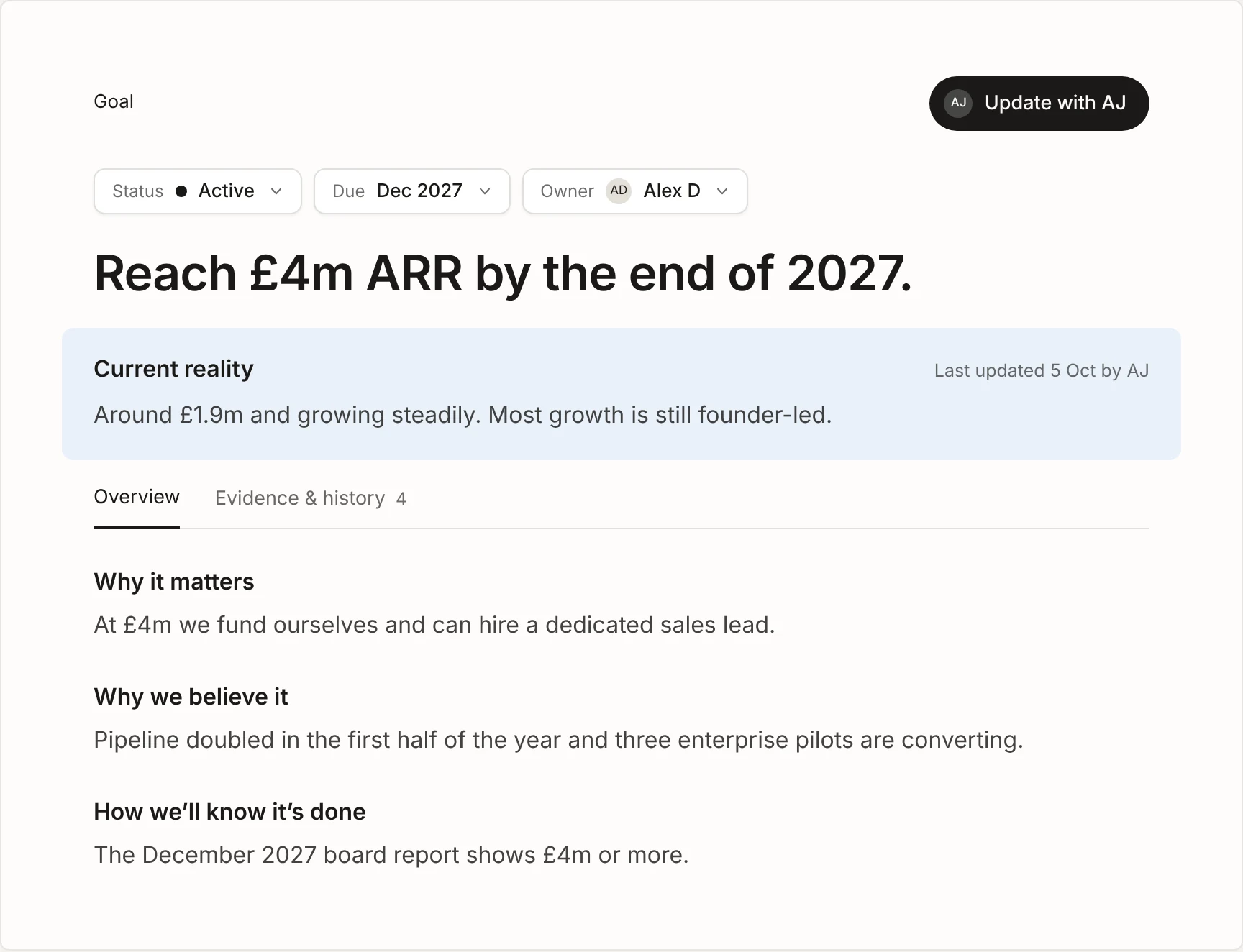
The goal, on one page.
What you’re aiming for, why it matters, how you’ll know it’s done and where it stands today, in your team’s words.
-
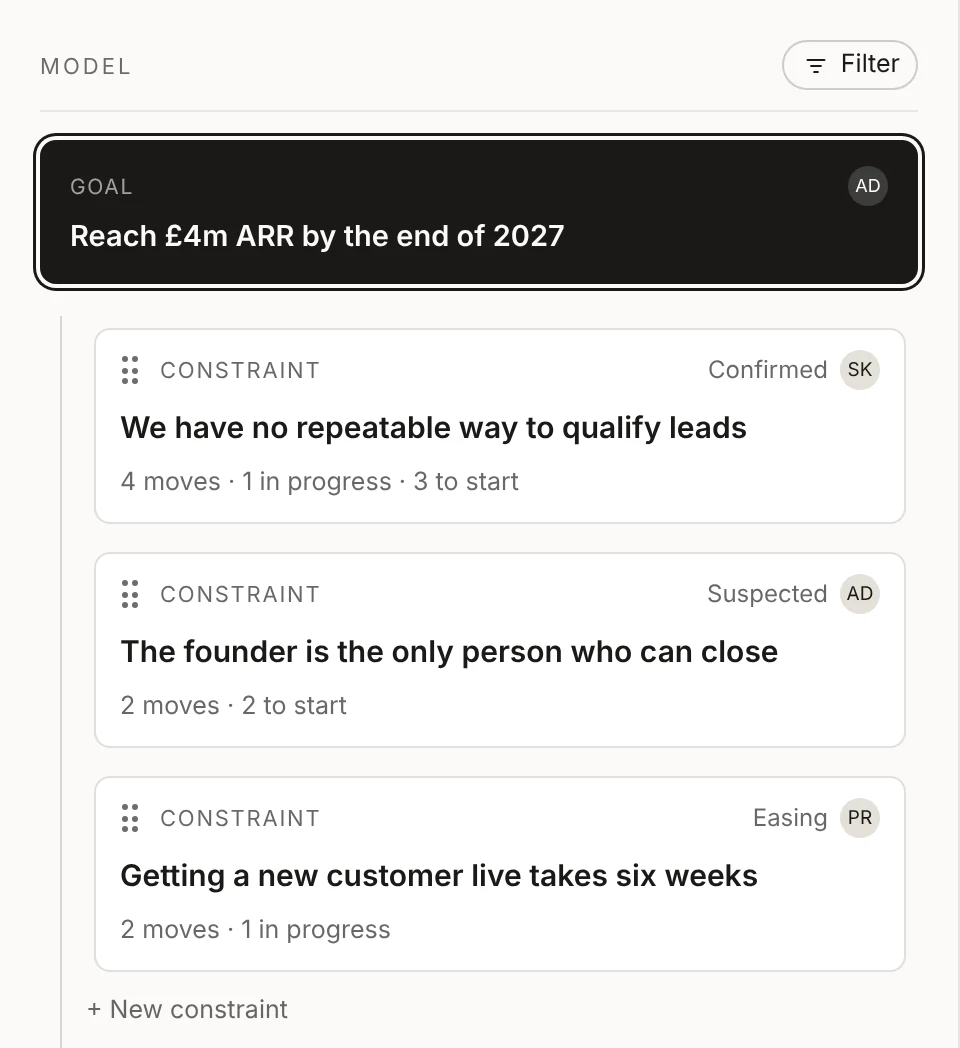
What’s holding it back, in order.
The few constraints really in the way, each with an owner and a status. Your team decides the order.
-
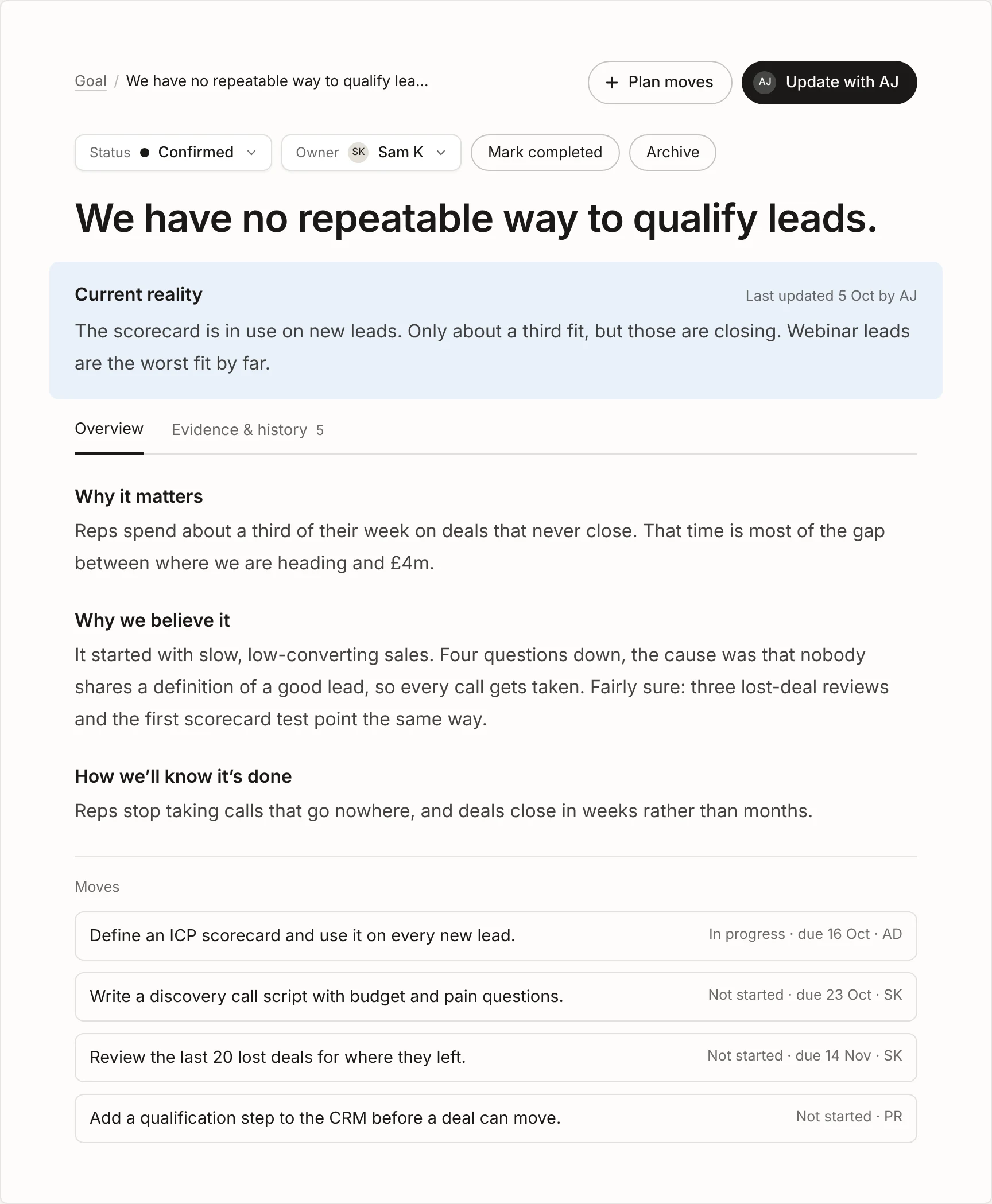
The moves, each with an owner.
Every move has a status, a due date and one person. They update AJ in a sentence when it moves.
-
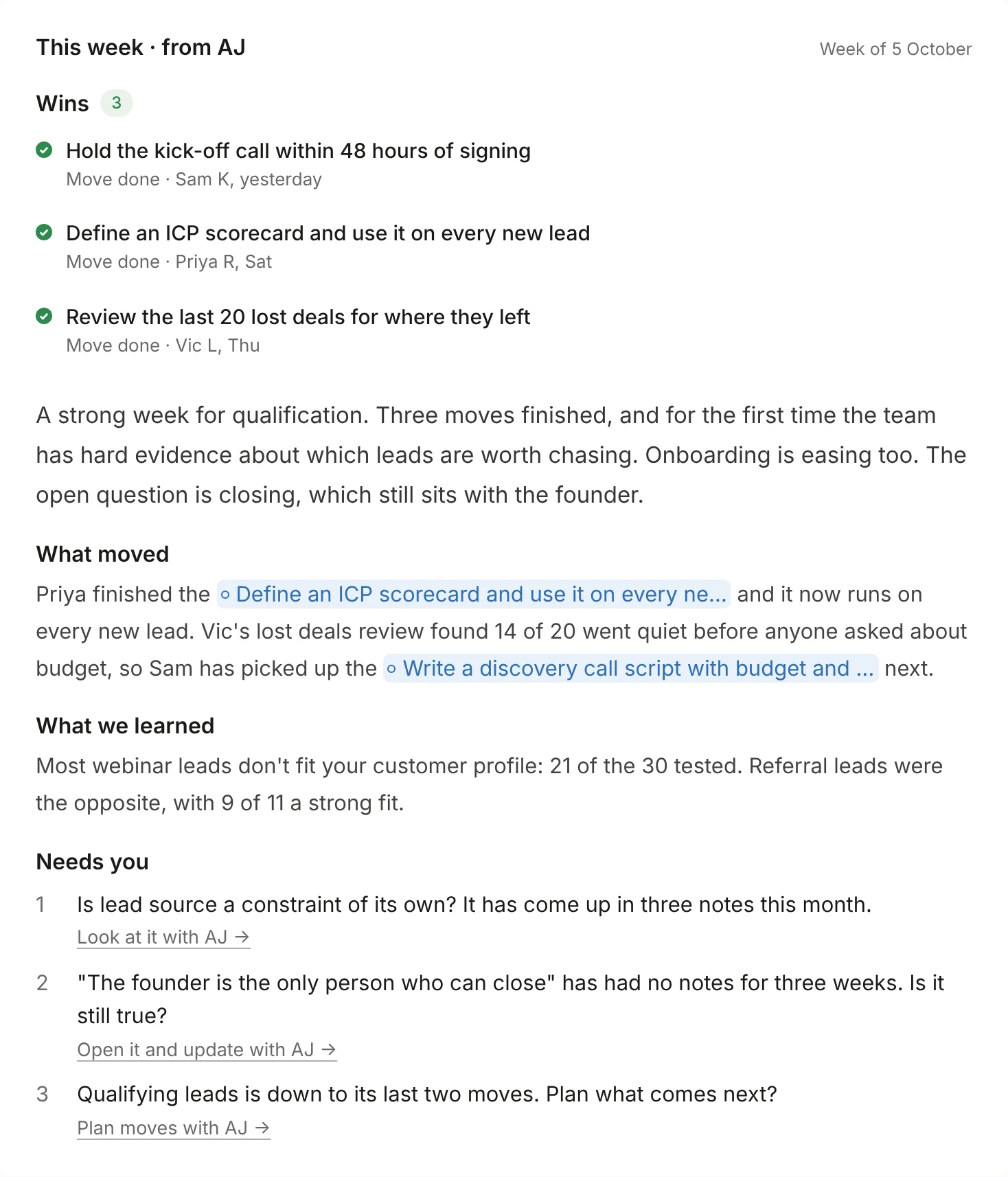
This week from AJ.
The wins, how it’s going and up to three things that need a decision, ready every Monday.
Run go-to-market alongside your other goals.
A go-to-market push rarely happens on its own. The same leadership team is usually trying to grow revenue in the core business, launch the product the GTM plan depends on, or raise the round the GTM results will be judged by. In most tools those become separate plans in separate places, and the links between them get lost.
In Clearahead each goal gets its own workspace with its own constraints, moves and weekly brief, up to 10 on the Clearahead plan. Your people and billing are shared across the organisation, so a head of sales can own moves in the GTM workspace and the revenue workspace, and see both in My work. Their summary email covers every workspace they’re in. When a GTM learning affects another goal, say a pricing change that hits revenue, you can see it on both, and nobody has to rebuild the story in a meeting.
If you’re taking an existing product into a new country rather than a new segment, see market expansion planning. If the GTM plan is part of a bigger push to grow the company, see scaling a company.
- Often run alongside Revenue growth planning Find what’s really capping revenue and get the whole team moving on it.
- Often run alongside Product launch planning Bring a new product to market with product, marketing and sales on one plan.
- Often run alongside Market expansion planning Take the business into a new country or segment without losing the home market.
- Often run alongside Fundraising planning Get ready to raise, run the round and keep investors close without a weekend of updates.
Who does what.
Three roles, enforced by the app. Everyone is included in one price.
-
CEO, COO or head of growth
ArchitectSets the GTM goal, agrees the constraints with the leadership team and makes the calls AJ says need them.
-
Sales, marketing, product and customer success leads
ContributorOwn constraints and moves, update AJ in a sentence and flag new constraints when the market answers back.
-
Board, investors and advisers
ViewerFollow the go-to-market in real time and ask AJ questions, without waiting for the board pack.
One price for every goal you run.
Free
£0
Up to 3 people and one workspace, with full access to AJ. No card needed.
Clearahead plan
£297 a month
Or £2,997 a year. Unlimited people and up to 10 workspaces, one for each goal. No seats to count.
Questions.
What is a GTM planning tool?
A go-to-market planning tool helps a company plan how it will take a product to customers and then track that plan as the work happens. Clearahead does that around one goal: it shows what’s holding your go-to-market back, the moves to clear it and who owns each one, with AJ keeping it current from short updates.
Do we still need a go-to-market strategy document?
Keep it if it helps, especially for positioning and messaging detail. Clearahead holds the part that has to stay live: the goal, what’s in the way and who’s doing what about it. Many teams paste the key points of their GTM doc into AJ to set up the first version.
Does it replace our CRM?
No. Keep HubSpot, Salesforce or Pipedrive for deals and contacts. Clearahead sits above them and tracks the goal your CRM activity is meant to serve, and the constraints in the way of it.
Can we use it for a GTM launch that’s still months away?
Yes. Many of the first constraints are about readiness: no agreed ideal customer, untested pricing, no sales collateral. Clearahead keeps those visible and owned well before launch day. For the launch itself, see product launch planning.
How is this different from OKRs for go-to-market?
OKRs score whether you hit key results. Clearahead organises the work around the constraints in the way of the goal, so when the number is behind you can see why and what’s being done. See OKRs vs Clearahead.
Can we run this alongside our other goals?
Yes. Each goal gets its own workspace with its own constraints, moves and weekly brief. The free plan has one workspace and the Clearahead plan includes up to 10, with your people and billing shared across them. See every use case.
How much does Clearahead cost?
Free for up to three people and one workspace, with full access to AJ and no card. Then £297 a month or £2,997 a year ($397 or $3,997) for the whole company, with unlimited people and up to 10 workspaces. See pricing.
Still have a question? Get in touch.
More ways teams use Clearahead.
- Profit improvement plan Profit improvement planning
- Scale-up planning tool Scaling a company
- Acquisition planning tool Acquisition planning
- AI adoption plan AI adoption planning
- Customer retention plan Customer retention planning
All use cases → Who Clearahead is for → Goal tracking software →
One go-to-market plan, owned by the whole team.
Free for up to 3 people. No card needed.