
The scale-up planning tool for companies outgrowing how they run.
Scaling is the point where what got you here stops working. The founder can’t be in every decision, the team can’t fit round one table, and the plan that lived in a few heads has to live somewhere everyone can see it. Clearahead gives a growing company one place for its goals, what’s holding each one back and who’s moving on it, with AJ, the AI inside it, keeping it current.
Free for up to 3 people. No card needed. Or speak to us.
What does scaling a company involve?
Scaling a company means growing revenue, customers and team faster than cost and complexity, so the business gets stronger as it gets bigger rather than just heavier. It usually involves building a leadership team, hiring ahead of demand, making sales and delivery repeatable, putting in the systems and processes a bigger company needs, and often raising money to fund it.
A scale-up plan sets out where the company is heading, say from 20 people to 80, or from £2m to £10m in revenue, and what has to change to get there. Some of it is about growth: new markets, new products, bigger customers. A lot of it is about the company itself: who decides what, how work gets prioritised, and how everyone stays pointed at the same goals as the team multiplies.
Why scaling is a leadership team job.
Most companies that stall during scale-up don’t run out of market. They run out of focus. Every new hire brings new ideas, every new customer brings new requests, and without a shared way of choosing, the company spreads itself across more priorities than it can finish. Growth slows at exactly the moment the costs have gone up.
The founder or CEO owns the scale-up, usually with a COO hired to make it happen, and a new layer of heads of department who each run part of it. The founder’s job changes from doing the work to setting direction and making the calls only they can make. That handover is the heart of scaling, and it’s where most of the pain is.
What makes the handover work is alignment: a leadership team that sees the same goals, agrees on what’s in the way and trusts each other to own their part. That’s also what makes a scale-up feel like one company rather than a set of departments. Read Built for the whole company for why we think the whole team should see the same picture, and Clearahead for founder-led companies if the founder is still the bottleneck.
What makes scaling a company hard.
The problems of scale are rarely new. They’re the problems of a small company that nobody had time to fix, multiplied.
-
The founder is still the bottleneck.
Every important decision waits for one person. The team grows, but the speed of the company is set by the founder’s diary.
-
Priorities multiply with headcount.
Each new leader brings a plan. Nobody chooses between them, so everything is a priority and nothing gets finished.
-
New hires can’t see the plan.
The strategy lives in the founders’ heads. Each new person has to guess what matters most, or wait for the next all-hands.
-
Process arrives all at once.
After a bad quarter, the company adopts a full framework. Keeping it up becomes a job, and the goal gets lost in the ritual.
-
Meetings grow faster than the team.
Status meetings, leadership meetings, department meetings. More time goes on finding out where things are than moving them.
How to plan and run a scale-up in Clearahead.
Start with the company goal, the destination for the next stage, in its own workspace: “Reach £10m ARR with a leadership team that runs the business without the founder in every decision”. Write why it matters and how you’ll know, so a new hire can read it on day one and understand where the company is going.
With AJ, work out what’s really holding the scale-up back. It’s often not what the board thinks. “Only the founder can close enterprise deals.” “We hire without a clear brief, so new managers take six months to land.” “Delivery depends on two people who are already at capacity.” AJ keeps asking why until you reach causes your team can change, and helps you put them in order. Each one gets an owner from the leadership team, which is how the founder hands things over without letting go of the direction.
As the company grows, add a workspace for each department or each big push, up to 10 on the Clearahead plan. Heads of department own their constraints and moves and update AJ in a sentence. This week from AJ replaces the status meeting, and the founder sees what’s on track and what needs them, without chasing anyone. There’s no framework to install and no consultant needed; the operating model is built into the way the app works. Read The operating model for the AI era for the thinking behind it.
- 01
Set the next-stage goal.
Talk AJ through where the company is going. Write a goal every new hire can read and understand.
- 02
Find what scale is breaking.
AJ helps you find the constraints in the way, from founder bottlenecks to hiring, and puts them in order.
- 03
Hand ownership to the team.
Each head of department owns constraints and moves. The founder keeps the direction and the big calls.
- 04
Add workspaces as you grow.
A workspace per department or per big push. Everyone’s summary email covers every workspace they’re in.
- Only the founder can close enterprise deals
- New managers take six months to land because we hire without a clear brief
- Delivery depends on two people already at capacity
- Write down how the founder runs an enterprise sale, step by step
- Have the head of sales lead the next three deals with the founder in support
- Agree which decisions in a deal still need the founder
An illustration, not a customer story.
What it looks like in Clearahead.
Real screens from the app. AJ keeps them up to date as your team works.
-
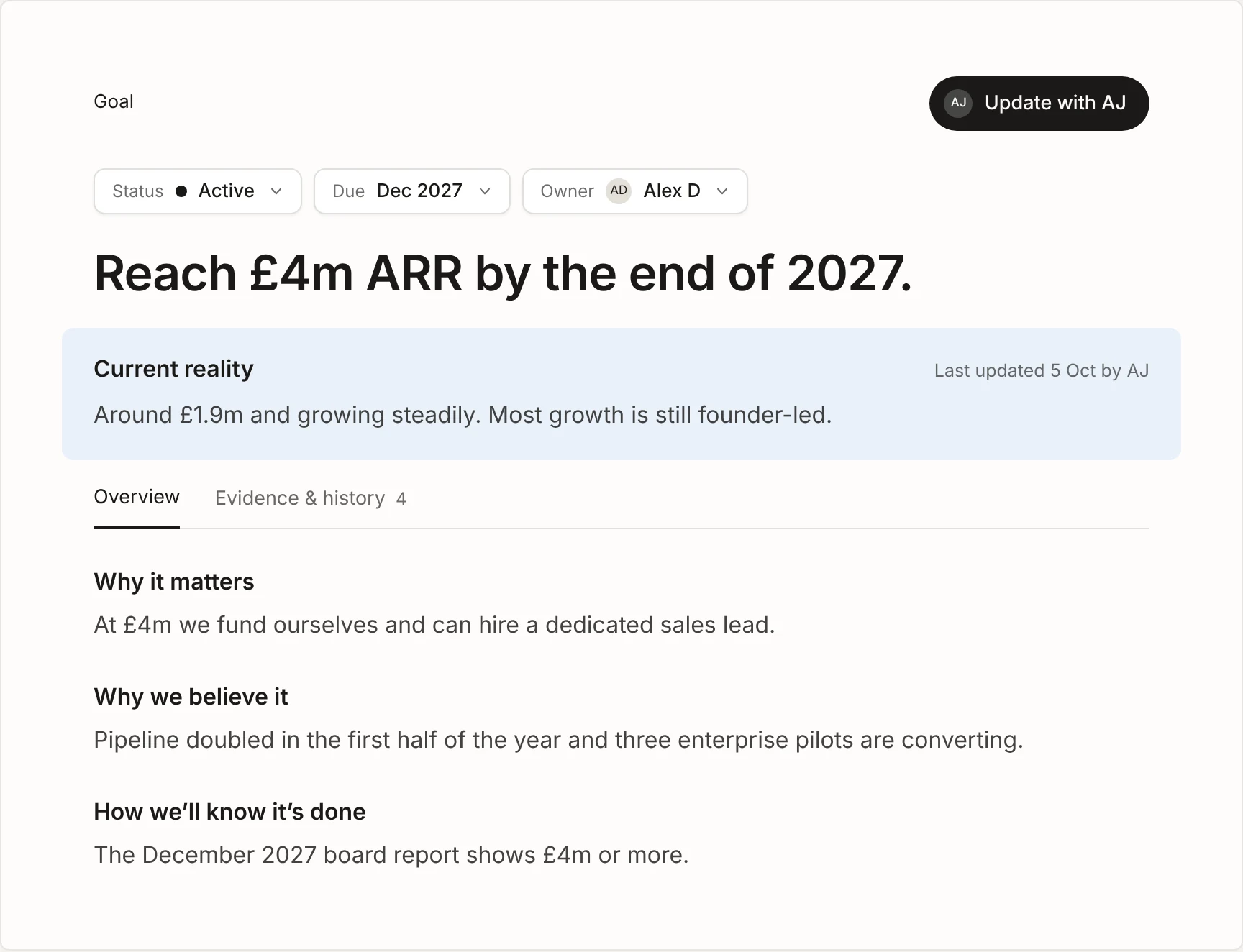
The goal, on one page.
What you’re aiming for, why it matters, how you’ll know it’s done and where it stands today, in your team’s words.
-
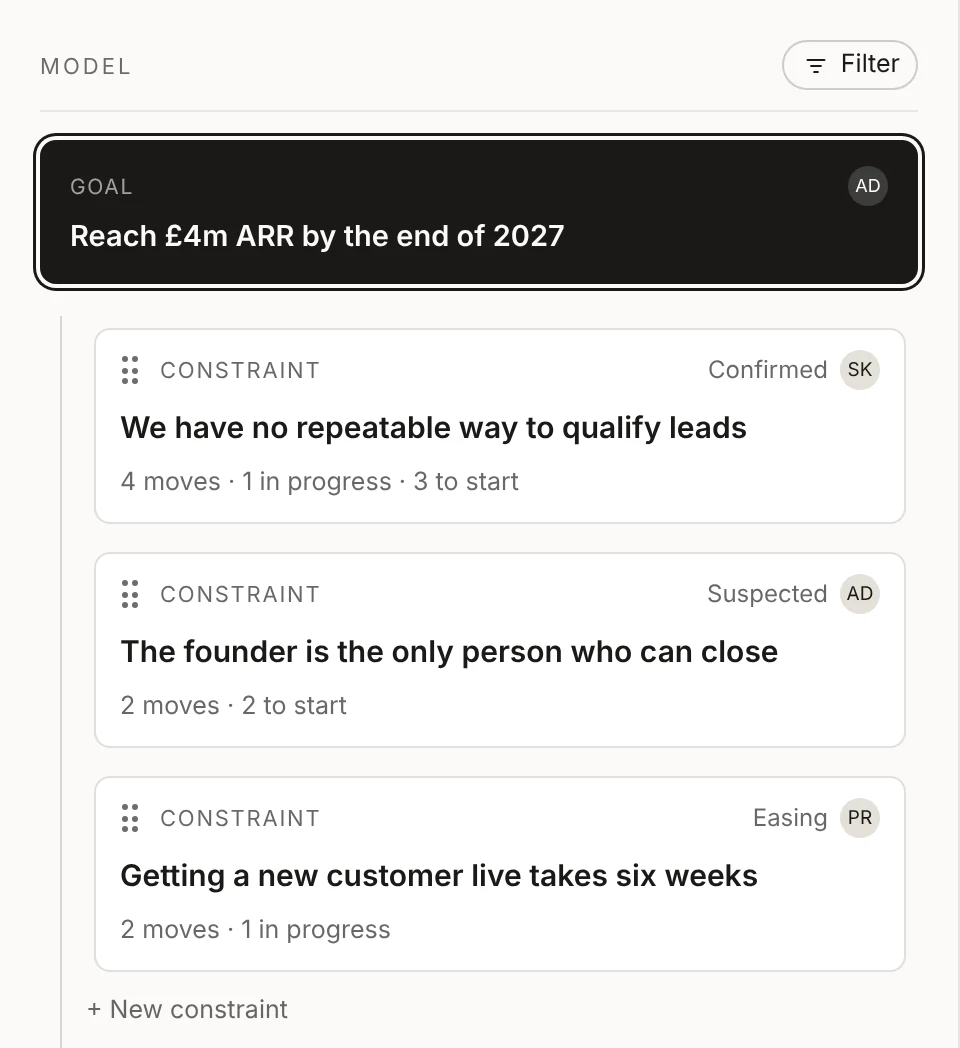
What’s holding it back, in order.
The few constraints really in the way, each with an owner and a status. Your team decides the order.
-
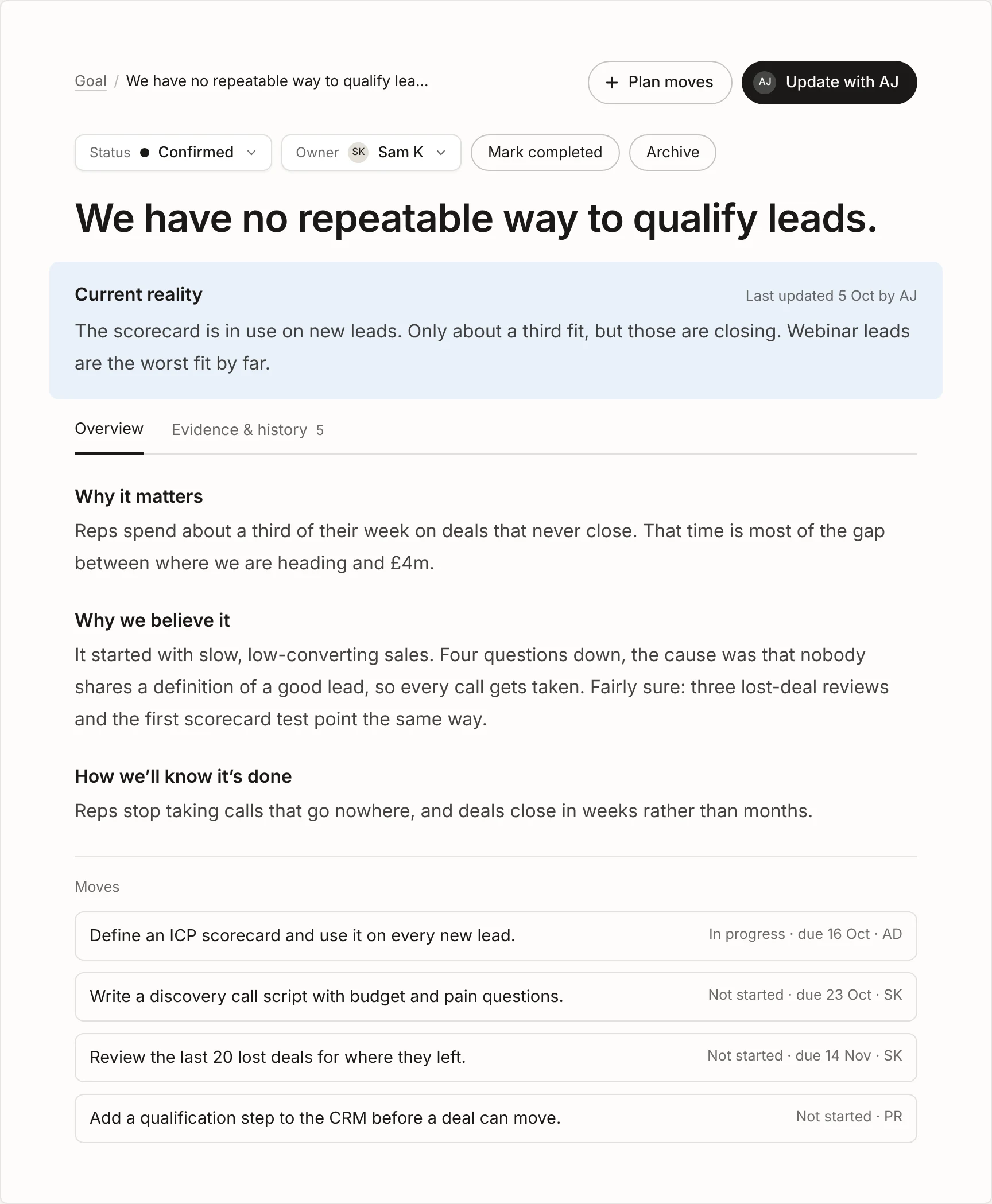
The moves, each with an owner.
Every move has a status, a due date and one person. They update AJ in a sentence when it moves.
-
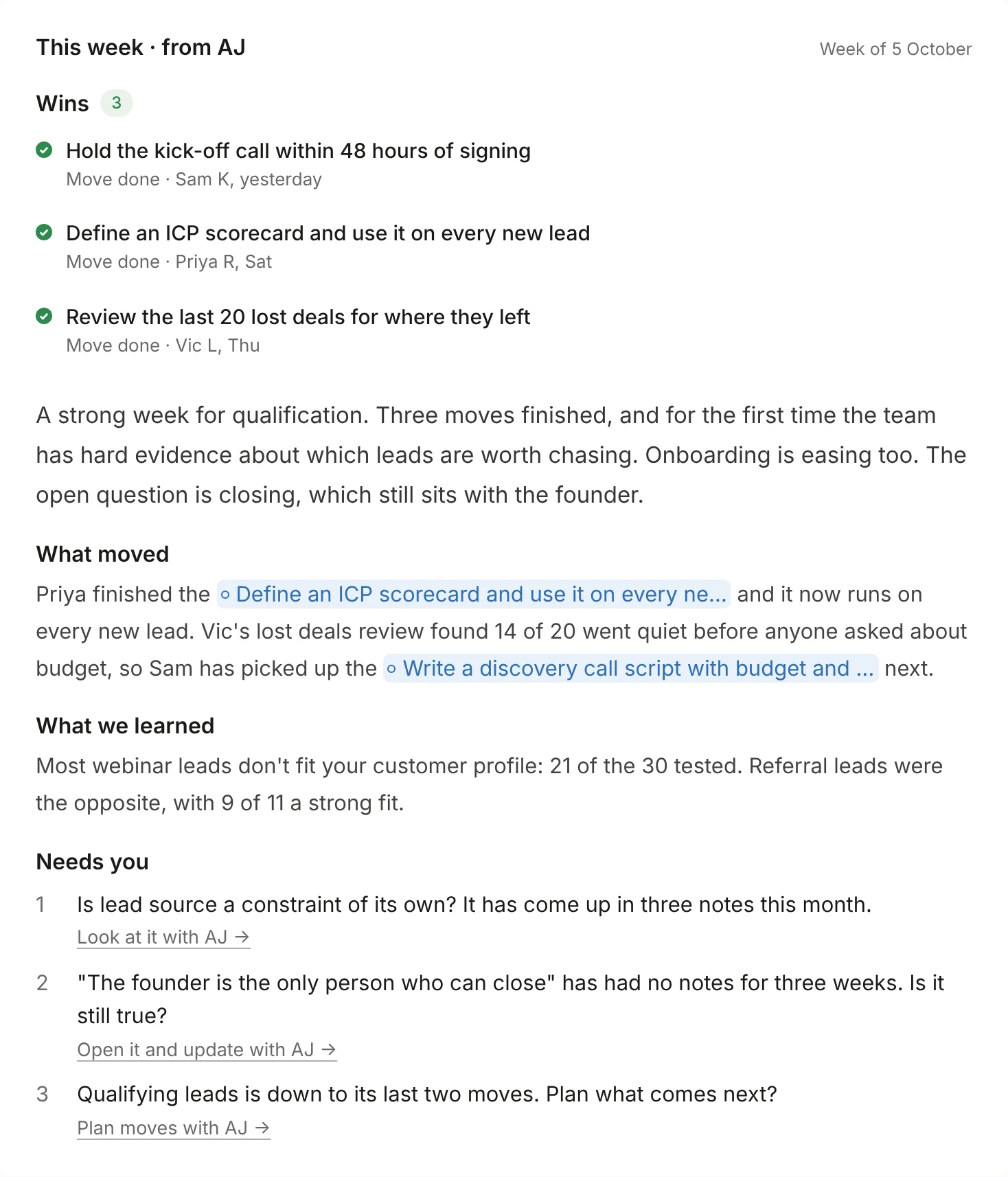
This week from AJ.
The wins, how it’s going and up to three things that need a decision, ready every Monday.
Scaling is several goals at once.
No company scales on one goal. A scale-up usually means growing revenue, raising the round to pay for it, opening a new market and maybe rebuilding how the company works with AI, all at the same time and with the same leadership team.
In Clearahead each of those gets its own workspace with its own constraints, moves and weekly brief. People and billing are shared across the organisation, and there’s no charge per person, so you can include everyone who works on a goal. A COO can see every goal in one place, while each head of department sees their own work across all of them in My work.
That’s what makes Clearahead an operating model rather than a planning document: the same simple loop, set the goal, find what’s in the way, move on it, find the next thing, runs for every goal in the company. If you’ve tried EOS or Scaling Up and found keeping the framework going became the job, see Scaling Up vs Clearahead and EOS vs Clearahead.
- Often run alongside Revenue growth planning Find what’s really capping revenue and get the whole team moving on it.
- Often run alongside Fundraising planning Get ready to raise, run the round and keep investors close without a weekend of updates.
- Often run alongside Market expansion planning Take the business into a new country or segment without losing the home market.
- Often run alongside AI adoption planning Roll out AI across the company with a goal the board can see, not a pile of pilots.
Who does what.
Three roles, enforced by the app. Everyone is included in one price.
-
Founder, CEO and COO
ArchitectSet the goals, agree what’s in the way and make the calls only they can make.
-
Heads of department and their teams
ContributorOwn the constraints and moves in their area and update AJ in a sentence.
-
Board, investors and advisers
ViewerFollow every goal in real time and ask AJ questions between board meetings.
One price for every goal you run.
Free
£0
Up to 3 people and one workspace, with full access to AJ. No card needed.
Clearahead plan
£297 a month
Or £2,997 a year. Unlimited people and up to 10 workspaces, one for each goal. No seats to count.
Questions.
What is a scale-up planning tool?
A scale-up planning tool helps a growing company plan the next stage and keep the whole team aligned as it grows. Clearahead does that with a workspace for each goal, the constraints holding it back and the moves to clear them, kept current by AJ.
At what size should we start?
From about four people, when alignment stops happening by itself, up to 200. The earlier you set up how you run, the less you have to unpick later. See Clearahead for startups.
Do we need to adopt a framework like EOS or Scaling Up?
No. Clearahead has its operating model built in, so there’s no framework to learn or implementer to hire. Some teams use it alongside a framework they already run.
How does it help the founder let go?
Each constraint has an owner from the leadership team. The founder sees progress in AJ’s Monday brief and only gets pulled in for the calls that need them, so ownership moves without the founder losing sight of the goal.
Will it replace our project management tools?
No. Keep Asana, Jira, Linear, Monday or Notion for the doing. Clearahead sits above them and decides what’s worth doing.
Can we run this alongside our other goals?
Yes. Each goal gets its own workspace with its own constraints, moves and weekly brief. The free plan has one workspace and the Clearahead plan includes up to 10, with your people and billing shared across them. See every use case.
How much does Clearahead cost?
Free for up to three people and one workspace, with full access to AJ and no card. Then £297 a month or £2,997 a year ($397 or $3,997) for the whole company, with unlimited people and up to 10 workspaces. See pricing.
Still have a question? Get in touch.
More ways teams use Clearahead.
- GTM planning tool Go-to-market planning
- Product launch planning tool Product launch planning
- Profit improvement plan Profit improvement planning
- Acquisition planning tool Acquisition planning
- Customer retention plan Customer retention planning
All use cases → Who Clearahead is for → Goal tracking software →
Grow the company without losing the plot.
Free for up to 3 people. No card needed.