
A profit improvement plan your whole leadership team can see and own.
Improving profit usually starts with a spreadsheet and ends with a round of cuts. The better way is slower to describe and faster to work: find the few things really eating your margin, and put the right people on fixing each one. Clearahead turns your profit improvement plan into one live model, with AJ, the AI inside it, keeping it current so the savings actually land.
Free for up to 3 people. No card needed. Or speak to us.
What is a profit improvement plan?
A profit improvement plan sets out how a company will increase its profit, or reach profitability, over a defined period. It looks at both sides of the equation: revenue quality, such as pricing, mix and discounting, and cost, such as delivery, overheads, tools and headcount. A good plan names a target margin or profit figure, the main levers to get there and who owns each one.
Profitability planning has become a priority for many growing companies. Funding is harder to raise on growth alone, and investors increasingly want a path to profit. For bootstrapped and founder-led businesses it was always the point. Either way, the plan has to improve the numbers without breaking the parts of the business that produce them.
Why profitability planning matters, and who owns it.
Profit is the company’s room to manoeuvre. It funds growth without dilution, gives you a buffer when the market turns and makes the business worth more when the time comes to raise or sell. A company that grows revenue while margins quietly erode is working harder every year for the same result.
Profit improvement is usually owned by the CEO and the finance lead, often with a COO running the programme. But the levers are spread across the company. Sales controls discounting. Delivery controls cost to serve. Product decides what gets built and what gets maintained. Operations owns the tools and suppliers. Finance can see where the margin goes, but it can’t change most of it on its own.
That’s why a profit improvement plan works best as a leadership team goal rather than a finance project. When every head of department can see the same target, the same causes and the same moves, cost decisions stop feeling like something done to them and start feeling like something they’re part of. And it means the reasons behind each decision are kept, not lost in an email thread.
What makes improving profit hard.
Profit plans are often right about the numbers and wrong about how the change will happen.
-
Cuts land on what’s easy, not what matters.
Tools, travel and freelancers go first because they’re visible. The structural cause of low margin stays put.
-
Finance sees it, nobody else owns it.
The analysis lives in a finance model. Department heads get a target, not an understanding of why.
-
Growth and profit pull in opposite directions.
Sales is told to grow and to stop discounting in the same quarter. Without a shared picture, each team picks the goal it prefers.
-
Savings don’t stick.
Costs drift back within months because nobody is watching the cause, only the line in the management accounts.
-
Morale takes the hit.
Profit programmes run behind closed doors breed rumours. People hear about the plan from the cuts.
How to run a profit improvement plan in Clearahead.
In Clearahead your profit goal gets its own workspace: for example, “Reach a 20% operating margin by the end of the financial year without slowing growth”. You set out why it matters and how you’ll know, and put today’s margin in the current reality at the top.
Then, with AJ, you trace the gap back to causes. Is it discounting? Cost to serve a particular kind of customer? Delivery work that never got productised? Tools nobody turned off? AJ keeps asking why until you reach constraints the team can actually change, and helps you put them in order, so the biggest real cause gets the attention first. This is the Theory of Constraints applied to margin: clear the one thing doing the most damage before spreading effort thinly across twenty savings.
Each constraint gets moves with an owner and a date. Owners update AJ in a sentence, and AJ keeps the figures and decisions as evidence, so you can see what was tried and what it saved. This week from AJ shows the leadership team progress every Monday and the calls that need them. Because the plan is open to everyone who works on it, people can see the reasons behind each change, which makes the savings far more likely to stick.
- 01
Set the profit goal.
Agree the margin or profit target, the date and what you won’t sacrifice to reach it.
- 02
Trace the gap to causes.
AJ helps you find the few constraints really eating margin, from pricing to cost to serve, and put them in order.
- 03
Put owners on every move.
Each head of department owns the moves in their area, so the plan is theirs, not finance’s.
- 04
Keep the savings honest.
Updates and figures go to AJ as evidence. The Monday brief shows what’s landed and what’s drifting back.
- Discounting has no rules, so most deals close below list price
- Small customers cost as much to serve as large ones
- We pay for tools and suppliers nobody has reviewed in two years
- Pull the last 12 months of discounts and who approved them
- Agree a discount policy with sales leadership
- Give account executives a pricing calculator with the new limits
An illustration, not a customer story.
What it looks like in Clearahead.
Real screens from the app. AJ keeps them up to date as your team works.
-
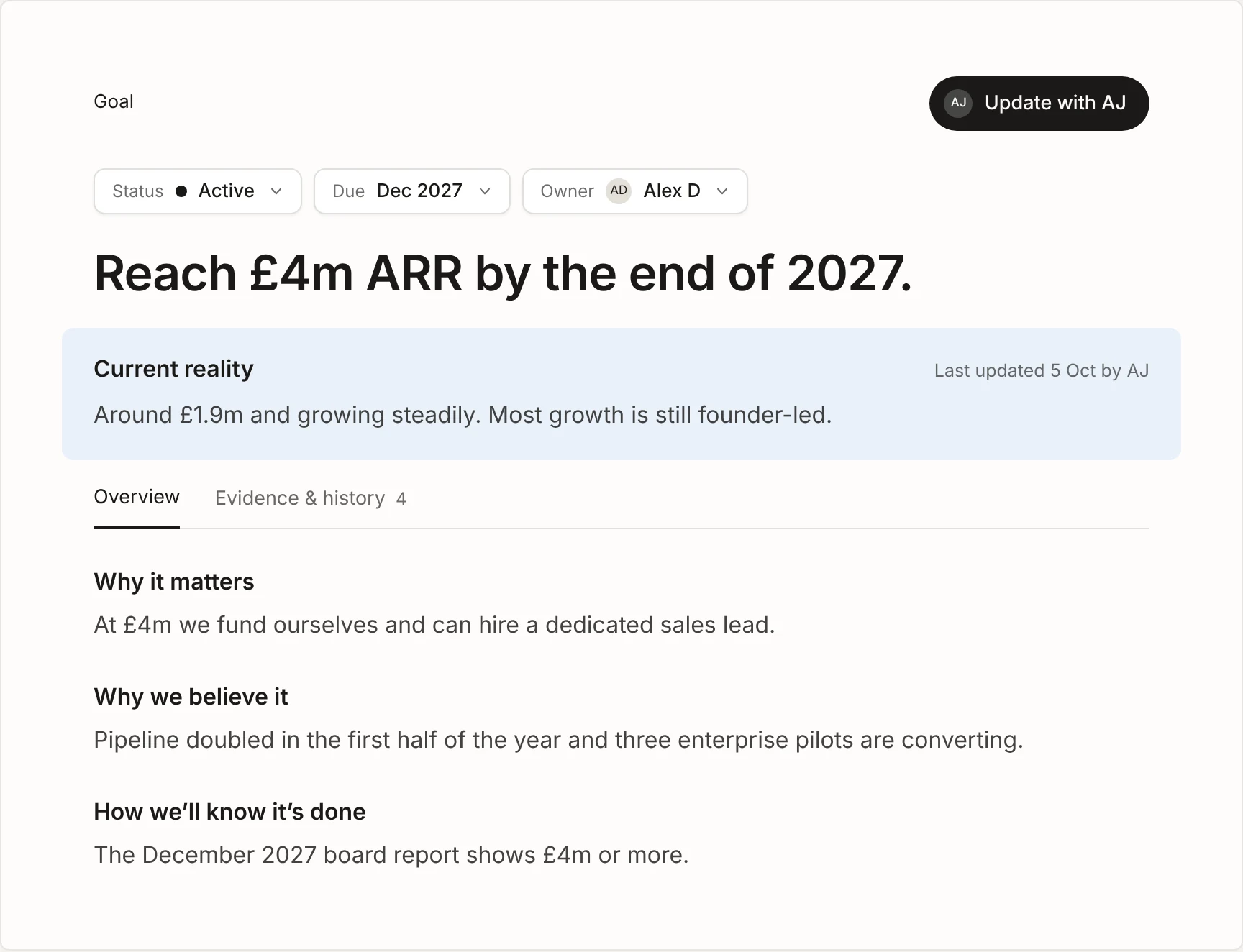
The goal, on one page.
What you’re aiming for, why it matters, how you’ll know it’s done and where it stands today, in your team’s words.
-
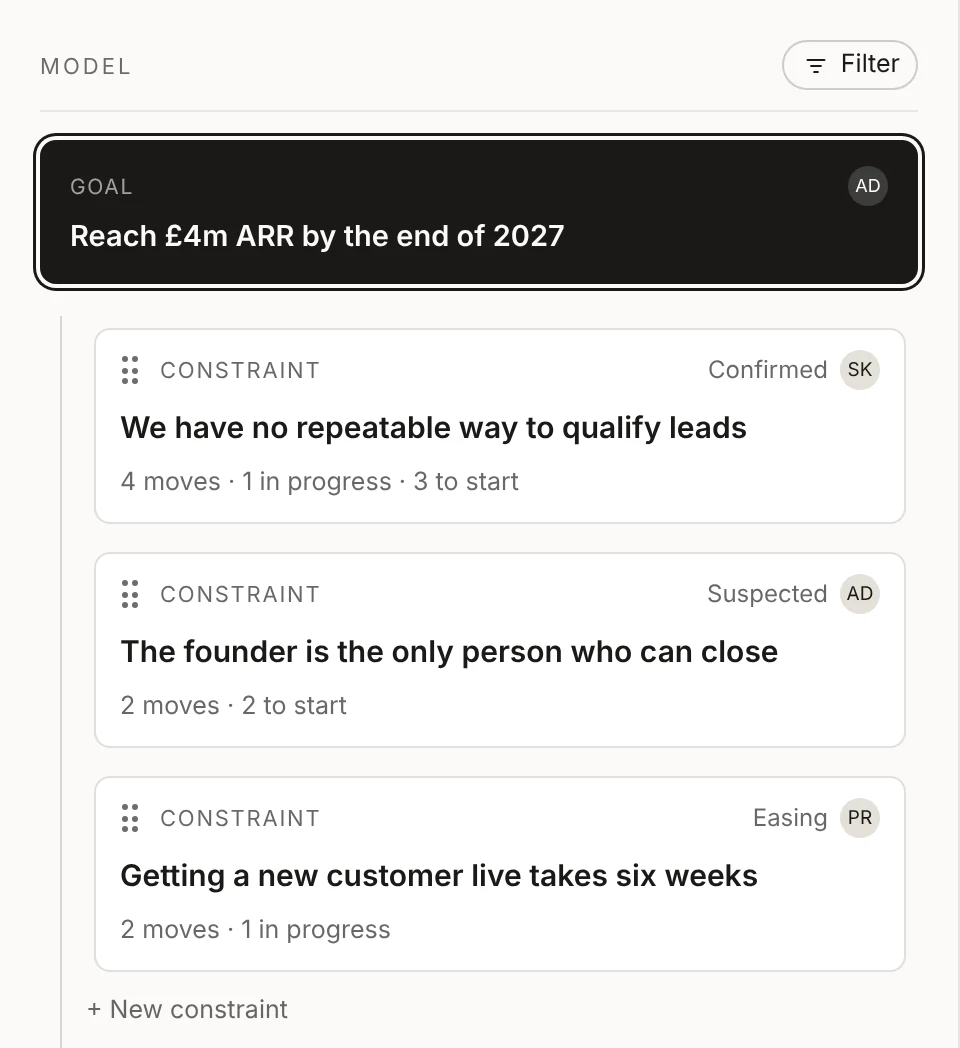
What’s holding it back, in order.
The few constraints really in the way, each with an owner and a status. Your team decides the order.
-
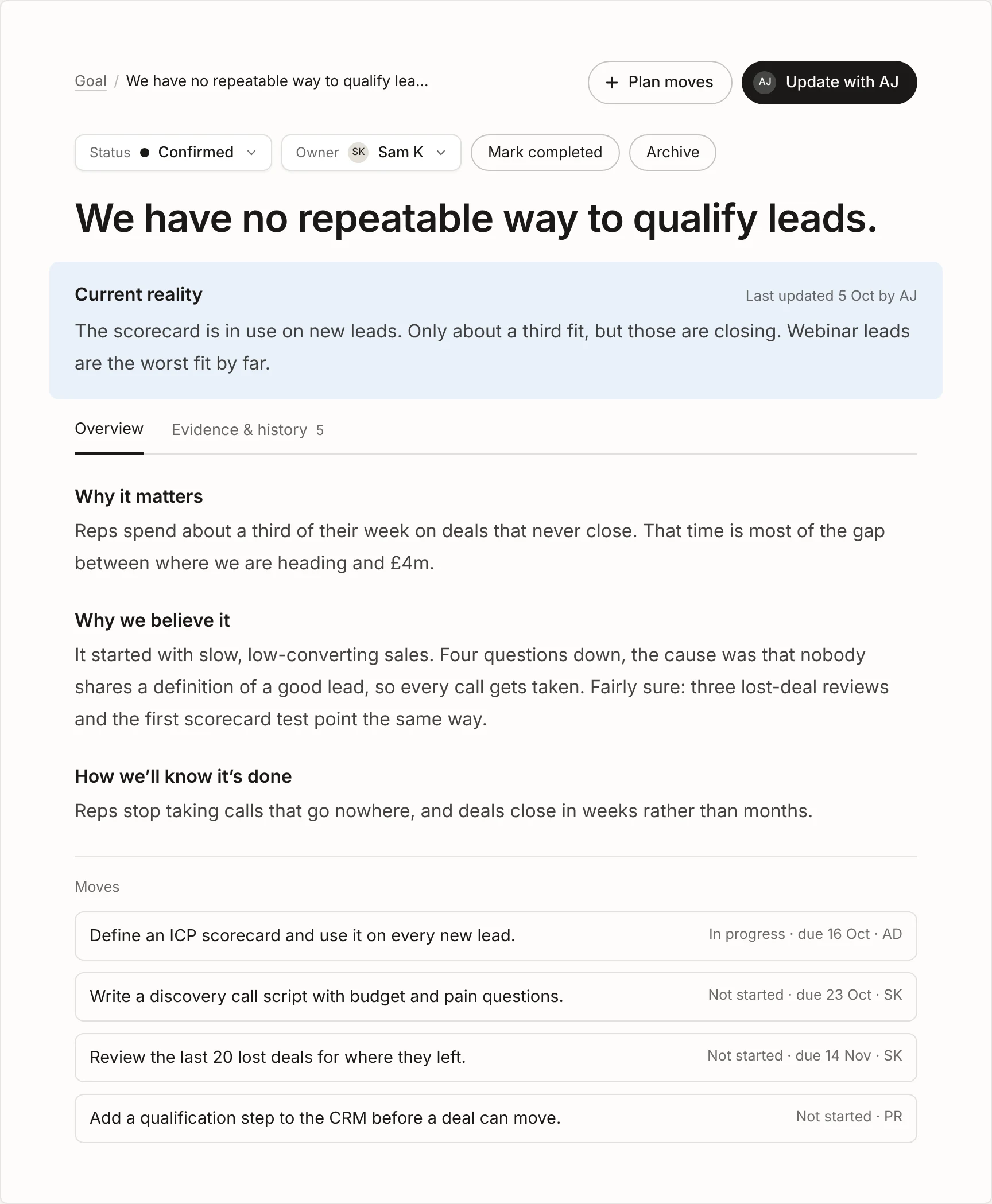
The moves, each with an owner.
Every move has a status, a due date and one person. They update AJ in a sentence when it moves.
-
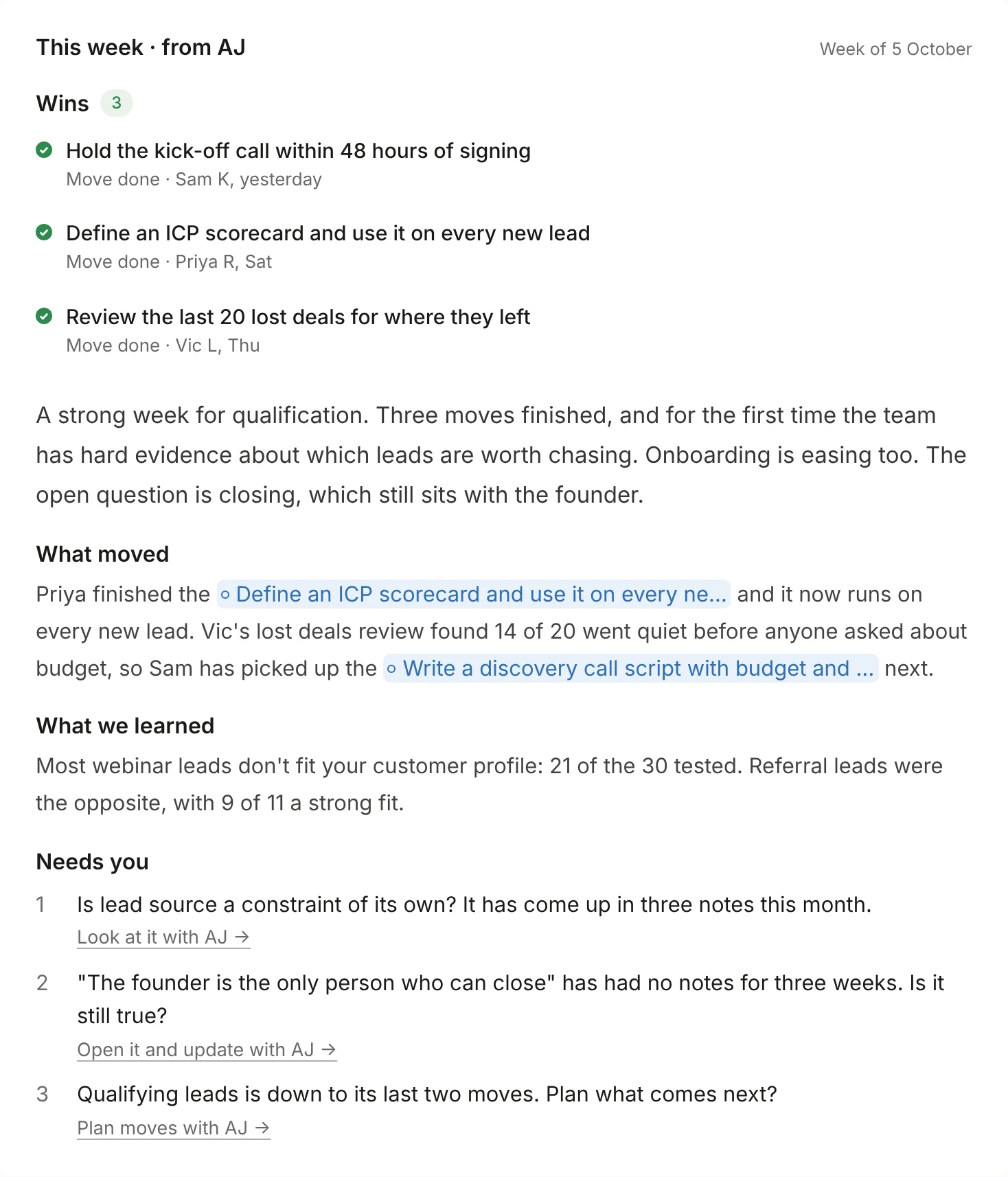
This week from AJ.
The wins, how it’s going and up to three things that need a decision, ready every Monday.
Improve profit without losing the growth.
The hardest part of a profit improvement plan is that it runs next to everything else. The same company is usually trying to keep revenue growing, hold on to customers and perhaps scale the team. Pull a margin lever too hard and one of those goals suffers.
With Clearahead, each goal has its own workspace, up to 10 on the Clearahead plan, with people and billing shared across the organisation. The leadership team can see the profit goal and the growth goal side by side, with the constraints and moves on each. When a pricing move in the profit workspace affects the revenue forecast, both owners see it. A head of sales who owns moves in both sees them together in My work.
Profit work often comes before a big event: a fundraise, an acquisition or a sale. A clear record of what was changed and why, kept as evidence in Clearahead, makes that story much easier to tell.
- Often run alongside Revenue growth planning Find what’s really capping revenue and get the whole team moving on it.
- Often run alongside Scaling a company Grow from a founding team to a company that runs without the founder in every decision.
- Often run alongside Acquisition planning Plan an acquisition and integrate the business so the deal delivers what it promised.
- Often run alongside Fundraising planning Get ready to raise, run the round and keep investors close without a weekend of updates.
Who does what.
Three roles, enforced by the app. Everyone is included in one price.
-
CEO, COO and finance lead
ArchitectSet the profit goal, agree the causes with the leadership team and make the calls AJ says need them.
-
Heads of department
ContributorOwn the constraints and moves in their area, and tell AJ what changed and what it saved.
-
Board, investors and advisers
ViewerFollow progress on margin and ask AJ questions, without waiting for the management accounts.
One price for every goal you run.
Free
£0
Up to 3 people and one workspace, with full access to AJ. No card needed.
Clearahead plan
£297 a month
Or £2,997 a year. Unlimited people and up to 10 workspaces, one for each goal. No seats to count.
Questions.
What is a profit improvement plan?
It’s a plan for increasing a company’s profit or reaching profitability over a set period, covering pricing, revenue mix and costs. In Clearahead it becomes a goal with the constraints eating your margin, the moves to fix them and an owner on each.
Does Clearahead replace our finance model?
No. Keep your model and management accounts in your finance tools or spreadsheets. Clearahead tracks the goal, the causes and the work to change them. Put the latest figures in the goal’s current reality.
Can we keep a cost-cutting plan confidential?
Everyone in your Clearahead organisation can see every workspace, so the reasons behind each change are open to the people affected. If a plan has to stay with a small group until decisions are made, run it in a separate organisation for that group. One login can belong to several organisations, and you switch in a click.
Is this only for loss-making companies?
No. It suits any company that wants better margins, including profitable businesses preparing for a raise, an acquisition or a sale.
How do we stop savings drifting back?
Keep the constraint open until the cause is fixed, not just the number. AJ flags constraints that go quiet, and the evidence shows what was changed, so drift is visible early.
Can we run this alongside our other goals?
Yes. Each goal gets its own workspace with its own constraints, moves and weekly brief. The free plan has one workspace and the Clearahead plan includes up to 10, with your people and billing shared across them. See every use case.
How much does Clearahead cost?
Free for up to three people and one workspace, with full access to AJ and no card. Then £297 a month or £2,997 a year ($397 or $3,997) for the whole company, with unlimited people and up to 10 workspaces. See pricing.
Still have a question? Get in touch.
More ways teams use Clearahead.
- GTM planning tool Go-to-market planning
- Product launch planning tool Product launch planning
- Market expansion planning tool Market expansion planning
- AI adoption plan AI adoption planning
- Customer retention plan Customer retention planning
All use cases → Who Clearahead is for → Goal tracking software →
Better margins, with the whole team behind them.
Free for up to 3 people. No card needed.