
The revenue growth planning tool that finds what’s really capping the number.
Every company wants more revenue. Most growth plans respond with more activity: more campaigns, more hires, more targets. Clearahead starts somewhere else. It helps your leadership team find the one or two things really holding revenue back, then puts the whole team on clearing them. AJ, the AI inside Clearahead, keeps the plan current, so you always know whether the number is moving and why.
Free for up to 3 people. No card needed. Or speak to us.
What is revenue growth planning?
Revenue growth planning is how a company decides how much it wants to grow, where that growth will come from and what has to change to get there. A revenue growth plan usually covers new customers, expansion from existing customers, pricing, retention and the capacity to deliver, along with the targets for each and the people responsible.
In practice there are only a few ways to grow revenue: win more customers, sell more to the customers you have, charge more, or lose fewer. A good plan is honest about which of those levers matters most right now, and what’s stopping it from moving. A weak plan sets a number for each team and hopes the total adds up.
Why revenue growth planning matters, and who owns it.
Revenue is the measure every other goal is eventually judged by. It funds hiring, buys time, sets the valuation for the next round and tells the team whether the strategy is working. When growth stalls, every other conversation in the company gets harder.
The CEO usually owns the revenue goal, with a COO, chief revenue officer or head of growth running it day to day. But revenue is the most cross-functional number in the business. Sales and marketing bring it in. Product makes it possible to charge for. Customer success keeps it. Finance tells you whether it’s profitable. No single team can move it alone, so revenue growth is always a leadership team goal.
The value of a good revenue plan isn’t the forecast. It’s that every head of department can see the same goal, the same reasons it’s behind and the same moves to fix it, and knows their part. That’s the difference between a team chasing ten targets and a team pulling on the same rope. Read Alignment beats activity for why that matters so much.
What makes revenue growth hard to plan.
Revenue plans tend to fail in the same few ways, and almost none of them are about effort.
-
The target is split, not solved.
The board number gets divided between teams. Each team hits its share, or doesn’t, and nobody owns the gap in between.
-
Activity stands in for progress.
More calls, more campaigns, more features. The dashboard is busy and the revenue line barely moves.
-
Nobody agrees why it’s behind.
Sales blames lead quality, marketing blames conversion, product blames positioning. The leadership meeting goes round in circles.
-
The forecast hides the cause.
Spreadsheets show the shortfall in detail. They can’t show which constraint is causing it or who’s fixing it.
-
The plan is set once a year.
The market changes in weeks. A revenue plan reviewed quarterly is steering by last season’s map.
How to plan revenue growth in Clearahead.
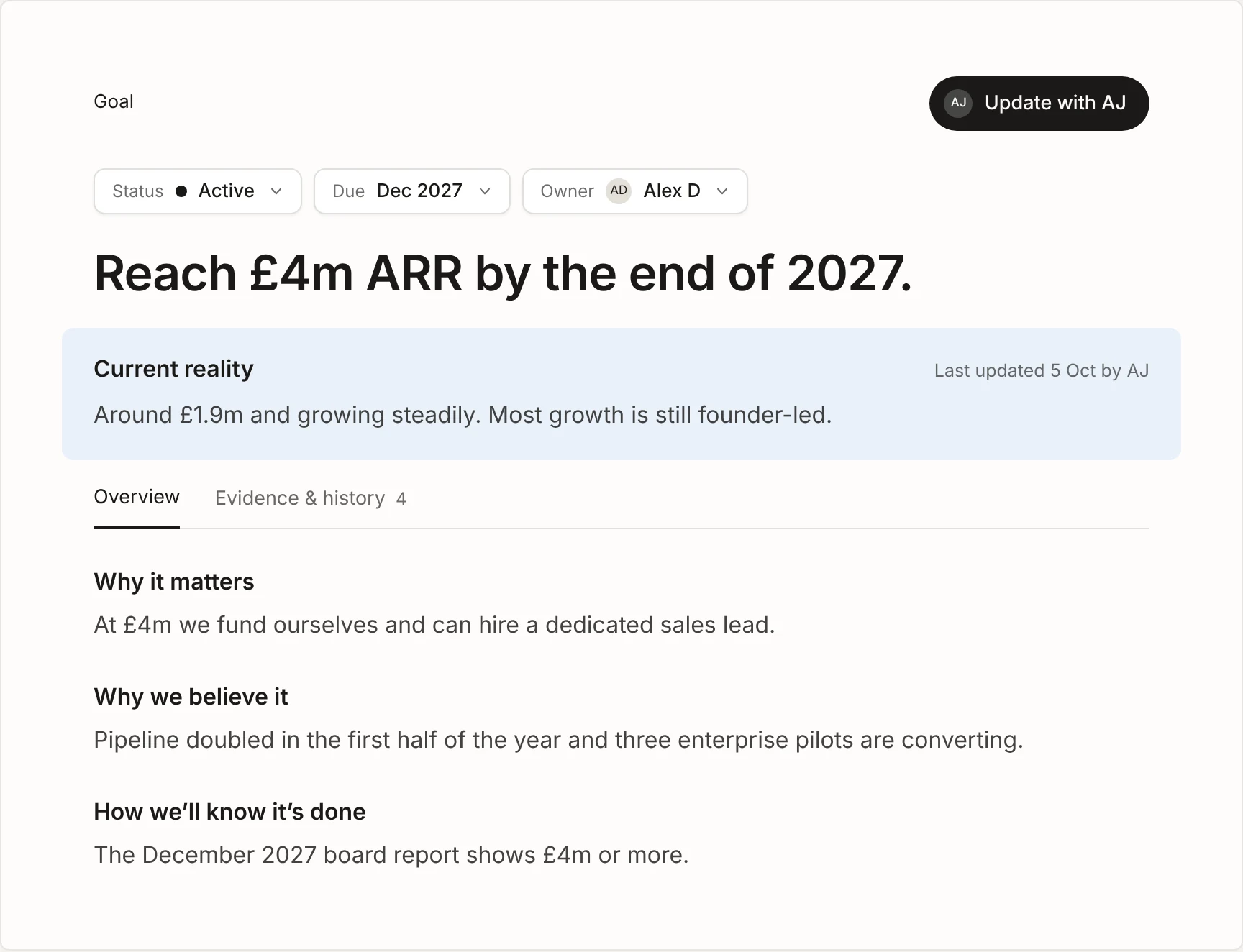
In Clearahead the revenue goal sits at the top of its own workspace: something like “Reach £4m ARR by the end of 2027”. Under the goal you write why it matters, why you believe it’s possible and how you’ll know it’s done, and the current reality sits right under the title so everyone starts from the same facts.
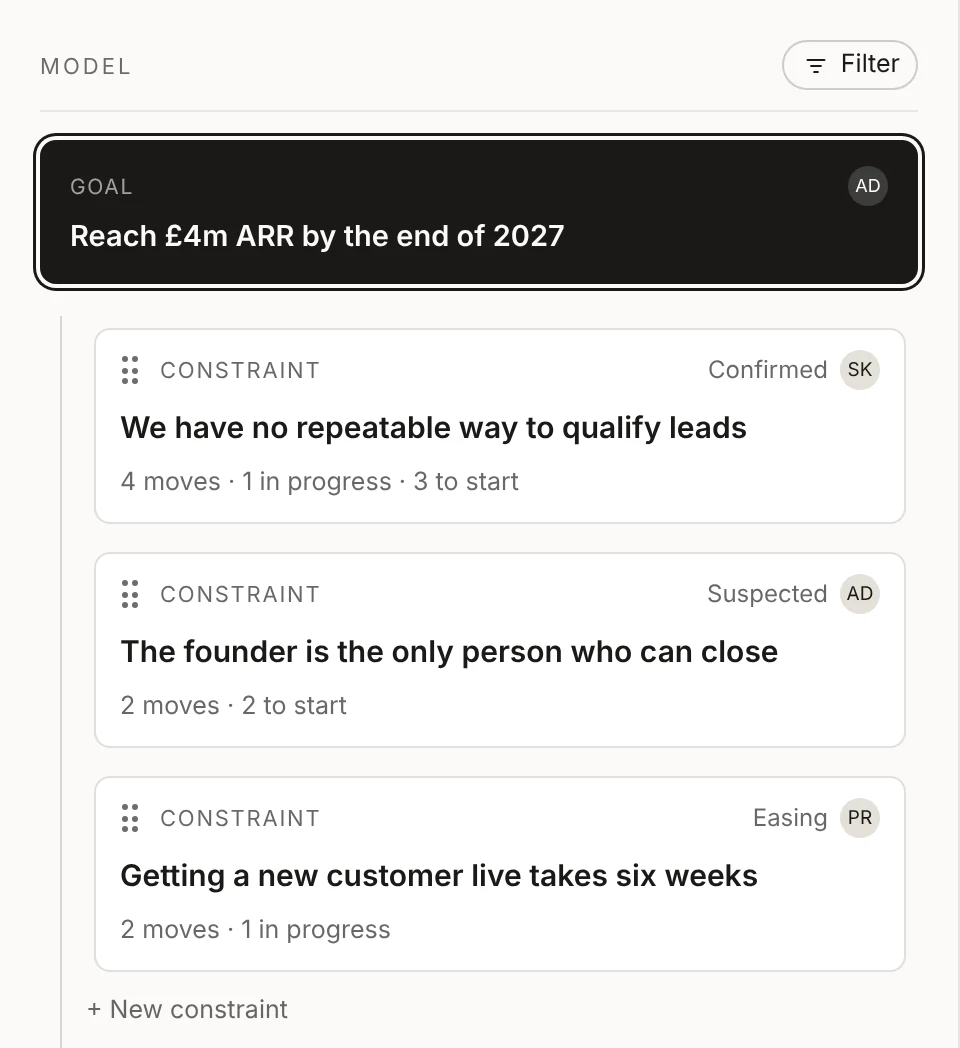
Then comes the part most revenue plans skip. With AJ you work out what’s really capping the number. AJ asks the questions a good chair would: where does revenue come from today, where is it leaking, what’s changed. It keeps asking why until you reach causes the team can change, like “We have no repeatable way to qualify leads” or “Customers don’t expand because we never review their usage with them”. Those become your constraints, in order. This is the Theory of Constraints applied to growth, and there’s more on it in Remove constraints, don’t add initiatives.
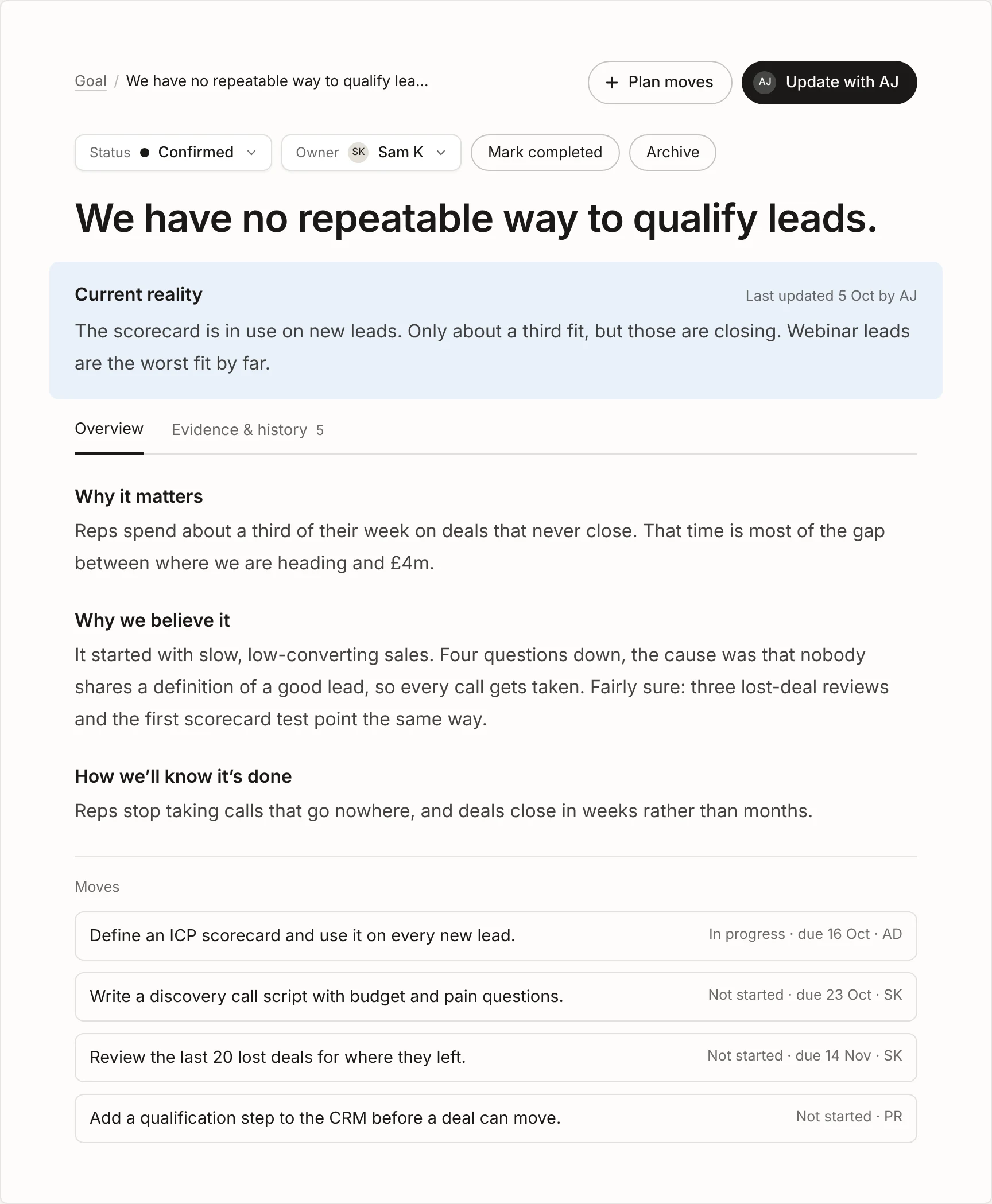
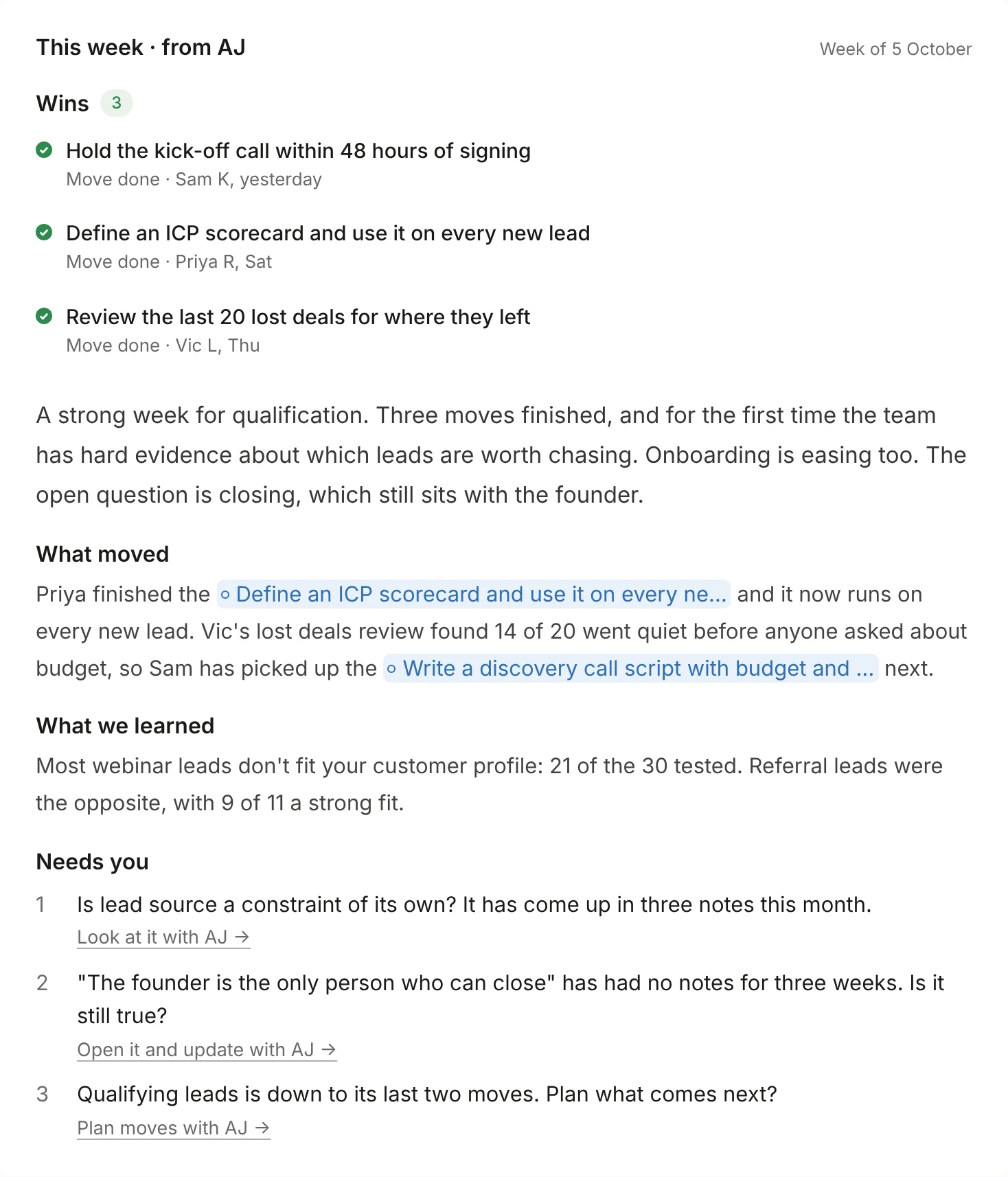
Each constraint gets a few moves, each with an owner and a date. When work moves, the owner tells AJ in a sentence. AJ updates the model, keeps the numbers and quotes as evidence, and carries the change up only as far as it matters. Every Monday This week from AJ gives the leadership team the wins, how revenue is tracking and up to three things that need a decision. When a constraint clears, AJ helps you find the next one, because once one bottleneck goes, another always takes its place.
- 01
Set the revenue goal with AJ.
Agree the number, the date, why it matters and how you’ll know. Put today’s reality under the title.
- 02
Find the real constraint.
AJ helps you trace the shortfall to the one or two causes your team can change, then put them in order.
- 03
Put moves behind each one.
Every move has an owner and a date. Heads of department own the constraints in their area.
- 04
Review weekly, not quarterly.
AJ’s Monday brief shows what moved and what needs a decision. Clear a constraint, find the next.
- We have no repeatable way to qualify leads
- Customers don’t expand because we never review usage with them
- Our pricing hasn’t changed since we had a third of the features
- Agree what a qualified lead looks like with sales and marketing
- Score every inbound lead the same way for a month
- Stop handing unqualified leads to account executives
An illustration, not a customer story.
What it looks like in Clearahead.
Real screens from the app. AJ keeps them up to date as your team works.
-
The goal, on one page.
What you’re aiming for, why it matters, how you’ll know it’s done and where it stands today, in your team’s words.
-
What’s holding it back, in order.
The few constraints really in the way, each with an owner and a status. Your team decides the order.
-
The moves, each with an owner.
Every move has a status, a due date and one person. They update AJ in a sentence when it moves.
-
This week from AJ.
The wins, how it’s going and up to three things that need a decision, ready every Monday.
Grow revenue alongside everything else the company is doing.
Revenue growth is usually the company’s main goal, but it’s rarely the only one. The same leadership team might be taking a product into a new segment, improving margins, cutting churn or raising money on the back of the growth story. Each of those deserves its own goal, constraints and owners, but they all touch the same revenue line.
Clearahead gives each goal its own workspace, up to 10 on the Clearahead plan, with people and billing shared. A head of sales can own moves in the revenue workspace and the go-to-market workspace and see both in My work. Leadership can see that a retention constraint is also capping revenue, or that a pricing move in the profit workspace will change the forecast, without anyone rebuilding the picture in a spreadsheet.
Some teams run revenue growth as the company-wide workspace and give each department its own workspace underneath. Others keep one revenue workspace and run the big pushes, a launch or a new market, as separate goals. Both work. If you want help deciding, try the cadence planner.
- Often run alongside Go-to-market planning Plan and run a go-to-market strategy across sales, marketing and product.
- Often run alongside Profit improvement planning Raise margins and profit without losing the momentum that got you here.
- Often run alongside Customer retention planning Find why customers leave and get every team working on keeping them.
- Often run alongside Scaling a company Grow from a founding team to a company that runs without the founder in every decision.
Who does what.
Three roles, enforced by the app. Everyone is included in one price.
-
CEO, COO or chief revenue officer
ArchitectSets the revenue goal, agrees what’s capping it and makes the calls AJ says need them.
-
Heads of sales, marketing, product and customer success
ContributorOwn the constraints in their area and the moves under them, and update AJ in a sentence.
-
Board, investors and advisers
ViewerSee how revenue is tracking and why, and ask AJ questions between board meetings.
One price for every goal you run.
Free
£0
Up to 3 people and one workspace, with full access to AJ. No card needed.
Clearahead plan
£297 a month
Or £2,997 a year. Unlimited people and up to 10 workspaces, one for each goal. No seats to count.
Questions.
What is a revenue growth planning tool?
A revenue growth planning tool helps a company set a revenue goal and plan how to reach it. Clearahead focuses on what’s really holding revenue back and the moves to clear it, each with an owner, kept current by AJ from short updates.
Does Clearahead do revenue forecasting?
No. Keep forecasting in your CRM, finance tool or spreadsheet. Record the latest figures in the goal’s current reality, and Clearahead tracks the constraints and moves that will change the forecast.
Can we connect it to our CRM?
No. You tell AJ the numbers that matter in a sentence, and AJ files them in the right place. Clearahead works alongside your CRM with nothing to integrate.
How is this different from setting sales targets?
Targets say how much each team should deliver. Clearahead shows what’s stopping the company reaching the total, which is often something no single team’s target covers, like qualification, pricing or onboarding.
We already use OKRs for revenue. Do we need this?
Many teams move from OKRs because scoring key results doesn’t show why the number is behind. See OKRs vs Clearahead for an honest comparison.
Can we run this alongside our other goals?
Yes. Each goal gets its own workspace with its own constraints, moves and weekly brief. The free plan has one workspace and the Clearahead plan includes up to 10, with your people and billing shared across them. See every use case.
How much does Clearahead cost?
Free for up to three people and one workspace, with full access to AJ and no card. Then £297 a month or £2,997 a year ($397 or $3,997) for the whole company, with unlimited people and up to 10 workspaces. See pricing.
Still have a question? Get in touch.
More ways teams use Clearahead.
- Product launch planning tool Product launch planning
- Acquisition planning tool Acquisition planning
- Fundraising planning tool Fundraising planning
- Market expansion planning tool Market expansion planning
- AI adoption plan AI adoption planning
All use cases → Who Clearahead is for → Goal tracking software →
Find what’s capping revenue. Then clear it together.
Free for up to 3 people. No card needed.