
A customer retention plan the whole company owns, not just customer success.
Churn is rarely one team’s fault and never one team’s fix. Customers leave because of the product, the onboarding, the promise sales made or the support they got, and usually a mix. Clearahead turns your customer retention plan into one live model: the retention goal, the real reasons customers leave and the moves to fix each one, with owners from every team. AJ, the AI inside Clearahead, keeps it current.
Free for up to 3 people. No card needed. Or speak to us.
What is a customer retention plan?
A customer retention plan sets out how a company will keep more of its customers and grow the value of the ones it has. It usually starts with a retention or churn target, such as net revenue retention or the share of customers who renew, then looks at why customers leave, which customers are at risk and what the company will change to keep them.
Churn reduction planning sits across the whole customer journey: who you sell to in the first place, how they get started, how quickly they see value, how they’re supported and how the product keeps up with what they need. A plan that only covers the renewal conversation is too late; most of the reasons a customer leaves were set months before.
Why retention matters, and who owns it.
Keeping a customer almost always costs less than winning a new one, and every customer you lose makes the revenue goal harder. For subscription businesses, retention compounds: a small improvement in churn changes the shape of revenue for years. It’s also one of the first things investors ask about, because it shows whether customers really value what you sell.
Customer success or account management usually owns the retention number. But they can’t fix most of what drives it. Product decides whether the features customers asked for get built. Sales decides which customers come in and what they’re promised. Onboarding and support decide the first experience. Leadership decides where resources go. That’s why retention works best as a leadership team goal, with each department owning its share of the causes.
When everyone can see the same retention goal, the same reasons customers leave and the same moves to fix them, the conversation changes. It stops being customer success defending the number and becomes the whole company working on keeping customers. Read Built for the whole company for why that shared picture matters.
What makes reducing churn hard.
Most churn plans treat the symptom at renewal. The causes sit upstream, in teams who don’t own the number.
-
One team owns a number many teams drive.
Customer success gets the target. Product, sales and onboarding shape the outcome but aren’t measured on it.
-
Exit reasons are vague.
“Budget” and “not using it enough” hide the real cause. Without digging, the plan fixes the wrong thing.
-
Save campaigns, not causes.
Discounts and last-minute calls rescue a few renewals. The next cohort leaves for the same reason.
-
Feedback gets lost on its way to product.
Customers tell account managers what’s wrong. It reaches the roadmap months later, if at all.
-
Bad-fit customers come in the front door.
Sales closes customers the product doesn’t suit. They churn on schedule, and the cycle repeats.
How to build a customer retention plan in Clearahead.
Give retention its own workspace with a goal the whole leadership team signs up to: “Raise net revenue retention from 92% to 105% by the end of next year”. Write why it matters and how you’ll know, and put today’s retention figures in the current reality so everyone starts from the same facts.
Then, with AJ, dig into why customers really leave. AJ asks the questions a good retention lead would: which customers churn, when, what did they say, what did they never do. It keeps asking why until “budget” becomes something your team can change, like “Customers never connect their data in the first month, so they never see value” or “We sell to companies too small to use half the product”. Those become your constraints, in order, each owned by the team that can fix it, which is often not customer success.
Moves go under each constraint with an owner and a date. Account managers tell AJ what customers say in a sentence, and AJ files it as evidence on the right constraint, so product sees customer feedback where it matters instead of in a ticket. Anyone can log a thought in Ideas without changing the plan. Every Monday, This week from AJ shows the leadership team how retention is moving and what needs a decision.
- 01
Set the retention goal.
Agree the measure, the target and the date. Put today’s numbers in the current reality.
- 02
Find why customers really leave.
AJ helps you trace churn to causes your team can change, and puts them in order.
- 03
Spread ownership across teams.
Product, sales, onboarding and success each own the constraints they can fix.
- 04
Keep customer evidence in view.
What customers say becomes evidence on the right constraint. AJ’s Monday brief shows the trend.
- Customers never connect their data in the first month, so they never see value
- We sell to companies too small to use half the product
- Customer feedback takes months to reach the product team
- Track which new customers have connected their data by day 14
- Call every customer who hasn’t, and book a setup session
- Build the connection step into the first onboarding call
An illustration, not a customer story.
What it looks like in Clearahead.
Real screens from the app. AJ keeps them up to date as your team works.
-
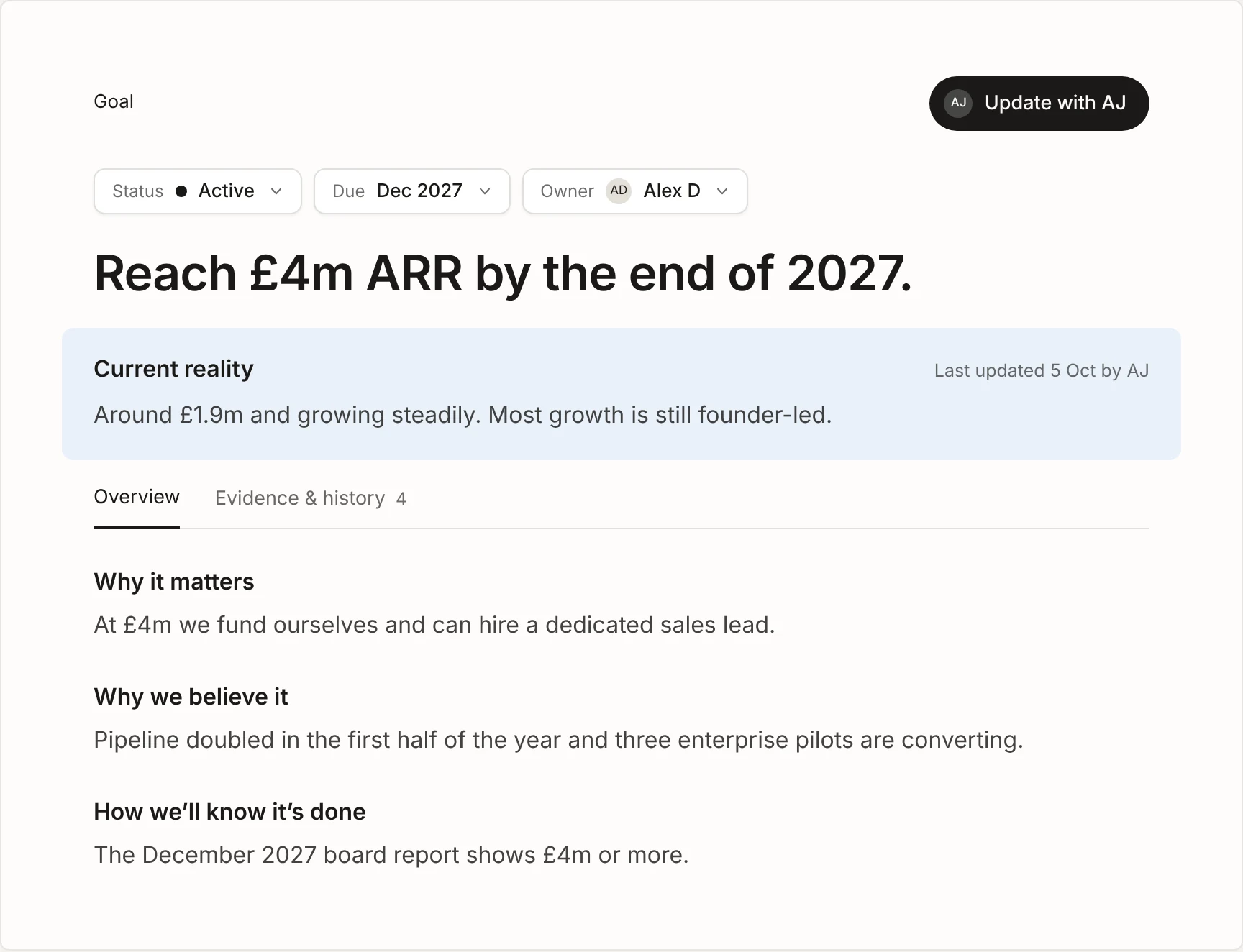
The goal, on one page.
What you’re aiming for, why it matters, how you’ll know it’s done and where it stands today, in your team’s words.
-
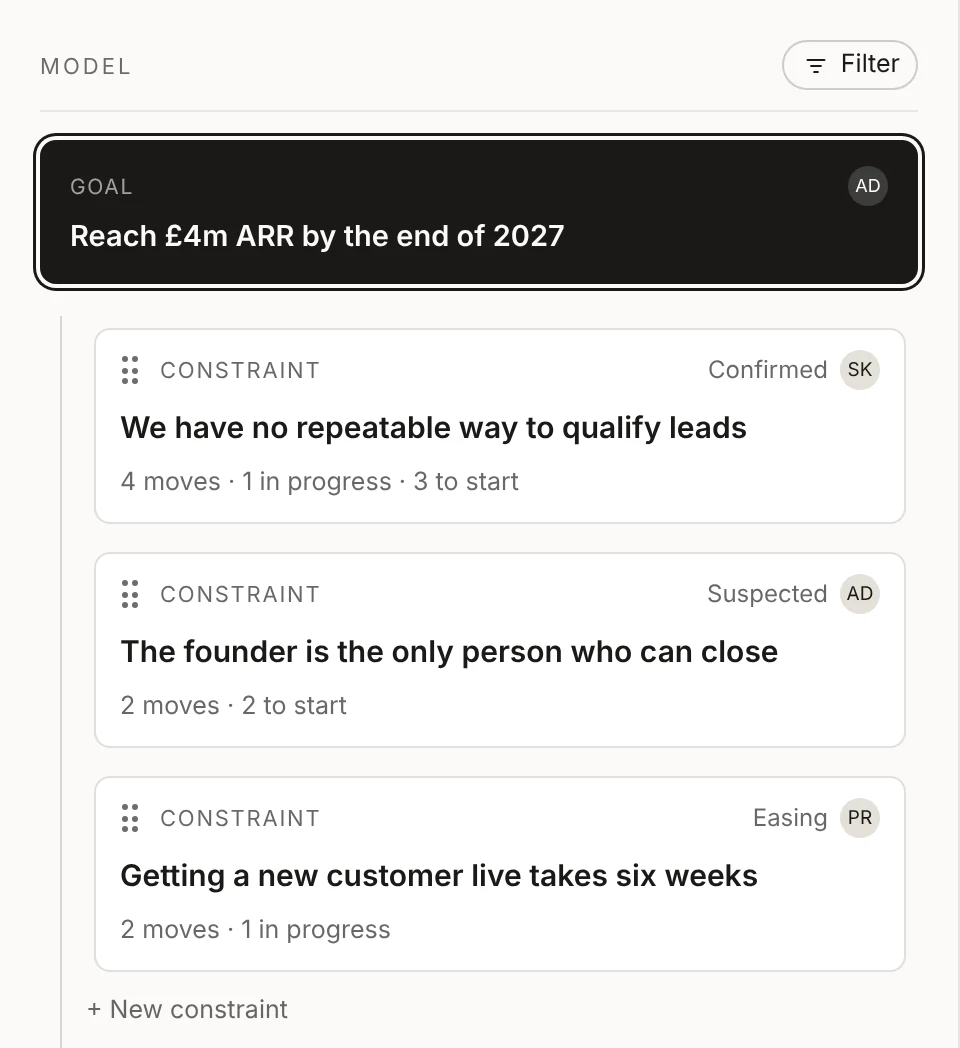
What’s holding it back, in order.
The few constraints really in the way, each with an owner and a status. Your team decides the order.
-
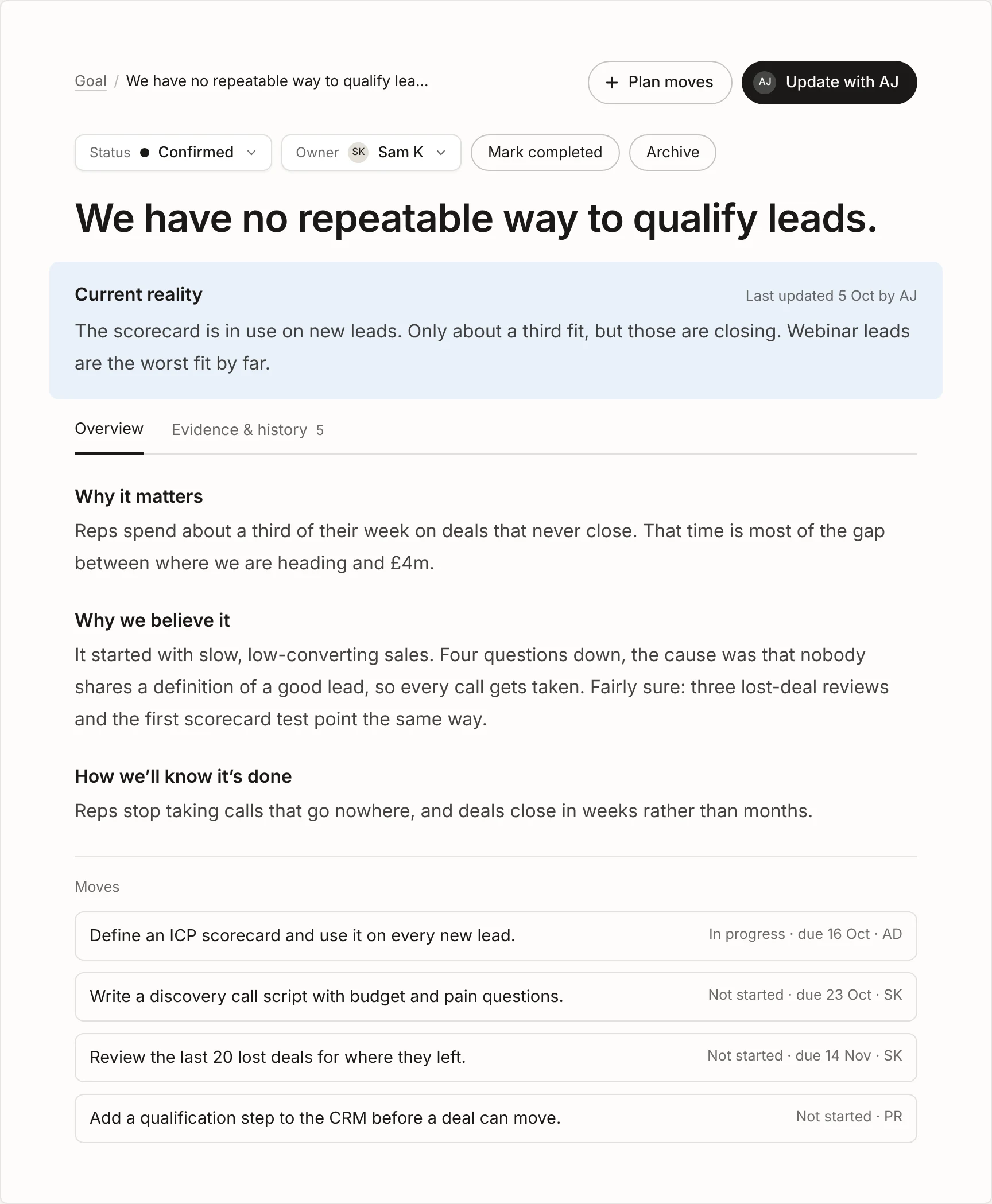
The moves, each with an owner.
Every move has a status, a due date and one person. They update AJ in a sentence when it moves.
-
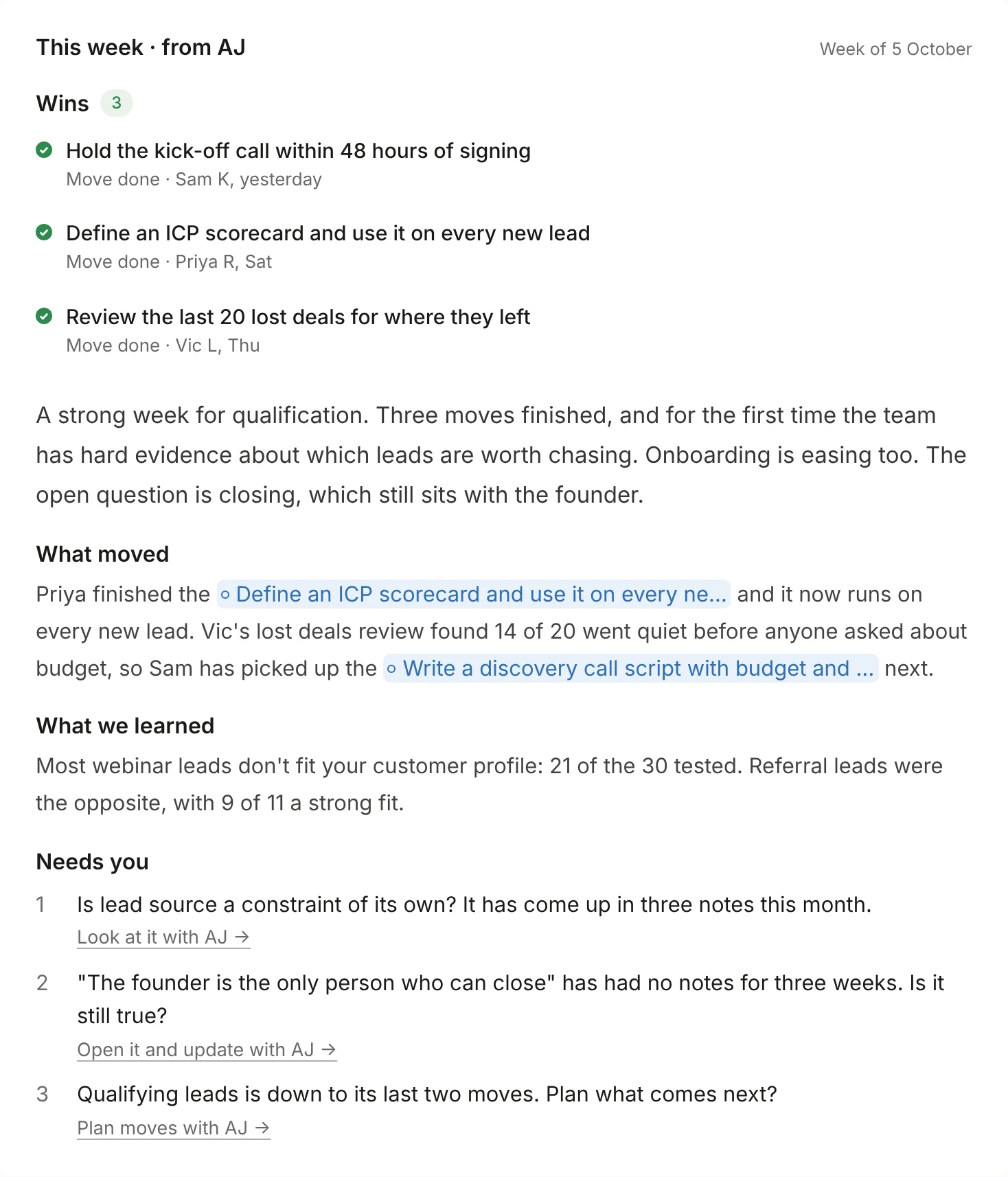
This week from AJ.
The wins, how it’s going and up to three things that need a decision, ready every Monday.
Retention runs through every other goal.
Retention touches almost everything else a company is trying to do. It’s half of revenue growth, a big part of profitability, and one of the first things investors check in a fundraise. A product launch or a new go-to-market can help it or hurt it, depending on who the new customers are.
In Clearahead, retention can have its own workspace next to the company’s other goals, up to 10 on the Clearahead plan, with people and billing shared across the organisation. Or, if retention is the main thing capping growth, make it a constraint in the revenue workspace. Either way, a head of customer success can see their retention moves and their revenue moves together in My work, and the leadership team can see how a change in one goal affects another.
If you’re acquiring a company, keeping its customers is usually the first constraint. See acquisition planning.
- Often run alongside Revenue growth planning Find what’s really capping revenue and get the whole team moving on it.
- Often run alongside Profit improvement planning Raise margins and profit without losing the momentum that got you here.
- Often run alongside Product launch planning Bring a new product to market with product, marketing and sales on one plan.
- Often run alongside Acquisition planning Plan an acquisition and integrate the business so the deal delivers what it promised.
Who does what.
Three roles, enforced by the app. Everyone is included in one price.
-
CEO, COO or chief customer officer
ArchitectSets the retention goal, agrees why customers leave and makes the calls AJ says need them.
-
Heads of customer success, product, sales and support
ContributorOwn the constraints their team can fix, log what customers say and update AJ in a sentence.
-
Board, investors and advisers
ViewerFollow how retention is moving and why, and ask AJ questions any time.
One price for every goal you run.
Free
£0
Up to 3 people and one workspace, with full access to AJ. No card needed.
Clearahead plan
£297 a month
Or £2,997 a year. Unlimited people and up to 10 workspaces, one for each goal. No seats to count.
Questions.
What should a customer retention plan include?
A retention goal, the real reasons customers leave, the moves to fix each one and an owner for every move, across all the teams that shape the customer experience. In Clearahead that’s one workspace, kept current by AJ.
Does Clearahead track churn automatically?
No. Keep churn data in your billing, CRM or customer success tool. Put the figures that matter in the goal’s current reality, and Clearahead tracks the causes and the work to fix them.
Does it replace our customer success platform?
No. Keep Gainsight, Vitally, HubSpot or whatever you use to manage accounts. Clearahead sits above them and tracks the retention goal and the constraints in the way of it.
Should retention be its own goal or part of revenue growth?
If retention is the main thing holding revenue back, make it a constraint in your revenue workspace. If it needs its own leadership focus and target, give it a workspace of its own.
How does customer feedback reach the product team?
Tell AJ what a customer said in a sentence. AJ files it as evidence on the right constraint, so the product team sees it in context, with who said it and when.
Can we run this alongside our other goals?
Yes. Each goal gets its own workspace with its own constraints, moves and weekly brief. The free plan has one workspace and the Clearahead plan includes up to 10, with your people and billing shared across them. See every use case.
How much does Clearahead cost?
Free for up to three people and one workspace, with full access to AJ and no card. Then £297 a month or £2,997 a year ($397 or $3,997) for the whole company, with unlimited people and up to 10 workspaces. See pricing.
Still have a question? Get in touch.
More ways teams use Clearahead.
- GTM planning tool Go-to-market planning
- Scale-up planning tool Scaling a company
- Fundraising planning tool Fundraising planning
- Market expansion planning tool Market expansion planning
- AI adoption plan AI adoption planning
All use cases → Who Clearahead is for → Goal tracking software →
Keep the customers you worked so hard to win.
Free for up to 3 people. No card needed.