
The fundraising planning tool for founders raising a round.
A raise is a project with a deadline, a story to prove and a founder who still has a company to run. Clearahead gives the round its own goal, an honest list of what investors will push on, and the moves to fix each one before the first meeting. AJ, the AI inside Clearahead, keeps it current, writes the weekly picture for you and lets investors follow along as Viewers once they’re interested.
Free for up to 3 people. No card needed. Or speak to us.
What is fundraising planning?
Fundraising planning is how a company prepares for and runs a funding round, whether that’s pre-seed, seed, Series A or a later round. It covers how much to raise and why, what milestones the money will reach, the story and the evidence behind it, the data room, the list of investors to approach, the timeline, and how the company will keep running while the founders are in meetings.
Most of a fundraise is decided before the first pitch. Investors are buying a story about where the company is going, and checking it against what has already happened. A good fundraising plan works backwards from what investors will need to believe, and makes sure the business can show it. That usually means a few months of real progress on the things that matter most, not a better deck.
Why the raise needs a plan, and who owns it.
A round sets the company’s runway, its valuation and often the next two years of its direction. Raise too little and you’re back on the road in a year. Raise on a weak story and the terms cost you more than the money is worth. And a raise that drags on pulls the founder away from the business for months, which makes the numbers worse just when they need to look their best.
The CEO owns the fundraise. Nobody else can. But a good raise is a team effort. The COO or a senior hire keeps the business running and the metrics moving. Finance builds the model and the data room. Heads of department own the progress that becomes the evidence. And advisers and existing investors help with introductions and challenge the story.
The founders who raise well tend to treat the round like any other company goal: clear target, clear reasons, clear owners, honest about what’s in the way. It also means investors can see a company that’s aligned and running well, which is often the thing they’re really assessing. For early-stage teams, see Clearahead for startups.
What makes fundraising hard to plan.
Raising money is hard for reasons that have little to do with the pitch.
-
The founder disappears.
Months of meetings pull the CEO out of the business. Without a plan the team can follow, progress slows when it matters most.
-
The story outruns the evidence.
The deck says the company is ready. The numbers, the pipeline or the team don’t back it up yet, and investors spot it.
-
Investor updates take a weekend.
Every update means rebuilding the month from Slack, spreadsheets and memory, every single time.
-
Weak points surface late.
The questions that kill a round, about retention, unit economics or the team, come up in diligence, not in preparation.
-
The timeline slips quietly.
The data room isn’t ready, the model needs another week, the intros haven’t been asked for. Each delay is small and they add up.
How to plan a fundraise in Clearahead.
Give the round its own workspace with a goal written the way an investor would read it: “Close a £2m seed round by June, with 18 months of runway to reach £1m ARR”. Write why it matters and how you’ll know. Put the facts as they stand in the current reality, so the starting point is honest.
Then talk AJ through what investors will push on. AJ asks the questions a sharp investor would: why now, what’s the evidence customers will pay, why this team, what happens to retention after month three. The answers you’re not happy with become your constraints, in order. “We can’t show retention beyond three months.” “Our pipeline depends on the founder.” “We have no data room.” Each one gets moves with an owner and a date, which also gives the team a plan to follow while the founder is pitching.
As the round goes on, people update AJ in a sentence. AJ keeps the numbers and quotes as evidence and writes This week from AJ every Monday: the wins, how it’s going and what needs you. That’s most of an investor update, already written. Once investors are interested, invite them as Viewers so they can read the goal and ask AJ questions any time, which shows them a company that runs well, not just a deck that looks good.
- 01
Set the round as a goal.
The amount, the date and what the money will reach. Put today’s numbers in the current reality.
- 02
Find what investors will push on.
AJ asks the hard questions early. The weak answers become constraints, in order.
- 03
Give the team a plan to run.
Owners and dates on every move, so the business keeps moving while the founder is out raising.
- 04
Let AJ write the updates.
The Monday brief becomes your investor update. Invite interested investors as Viewers.
- We can’t show retention beyond three months
- Pipeline depends on the founder, who’ll be out raising
- We have no data room or financial model investors can check
- Pull cohort retention for every customer since launch
- Interview the five customers who churned about why
- Agree one retention measure and report it weekly
An illustration, not a customer story.
What it looks like in Clearahead.
Real screens from the app. AJ keeps them up to date as your team works.
-
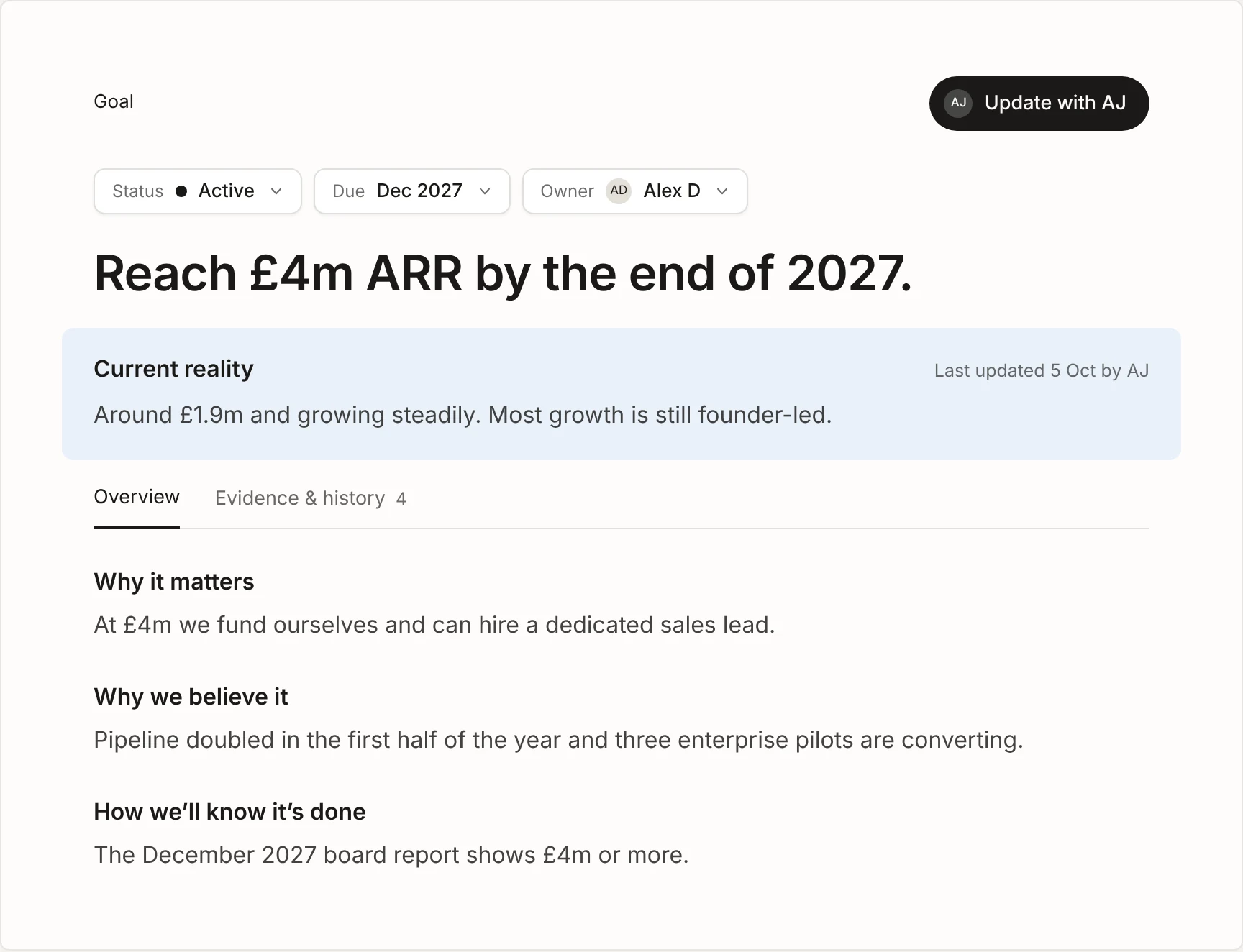
The goal, on one page.
What you’re aiming for, why it matters, how you’ll know it’s done and where it stands today, in your team’s words.
-
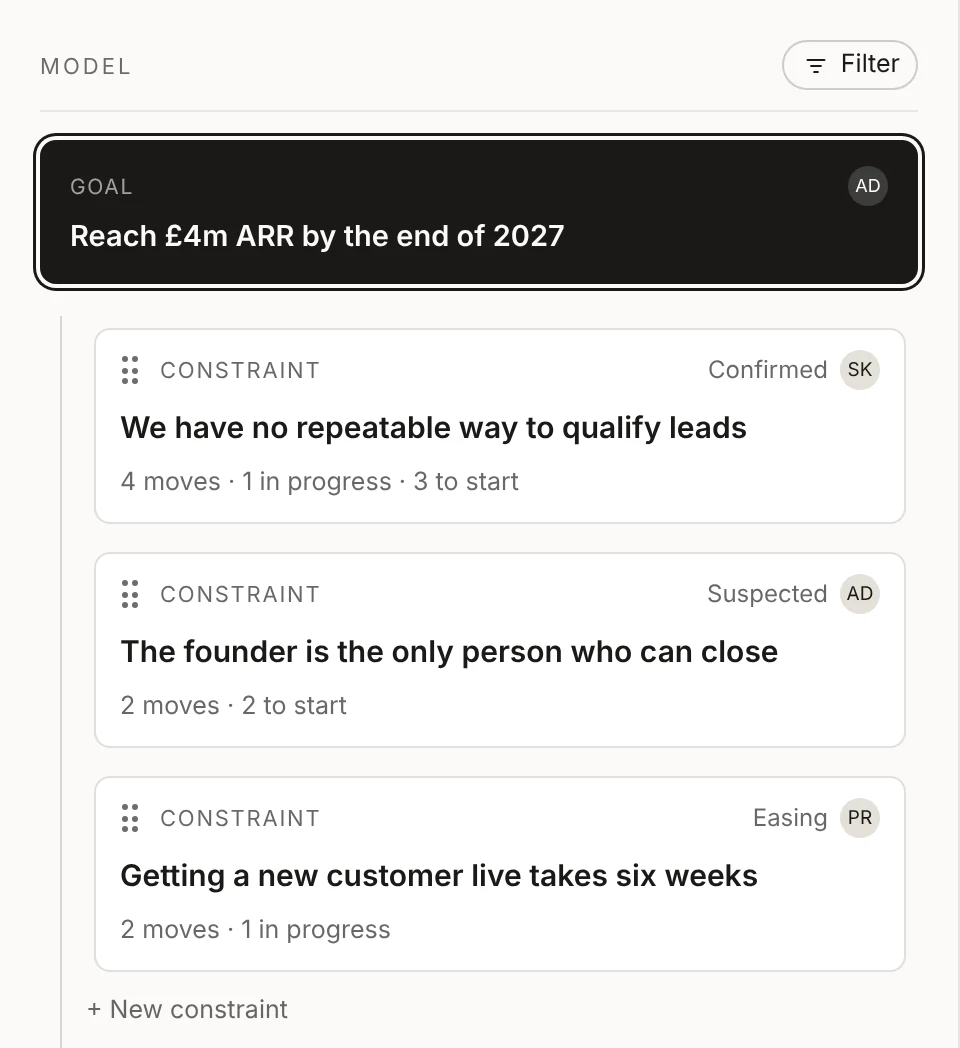
What’s holding it back, in order.
The few constraints really in the way, each with an owner and a status. Your team decides the order.
-
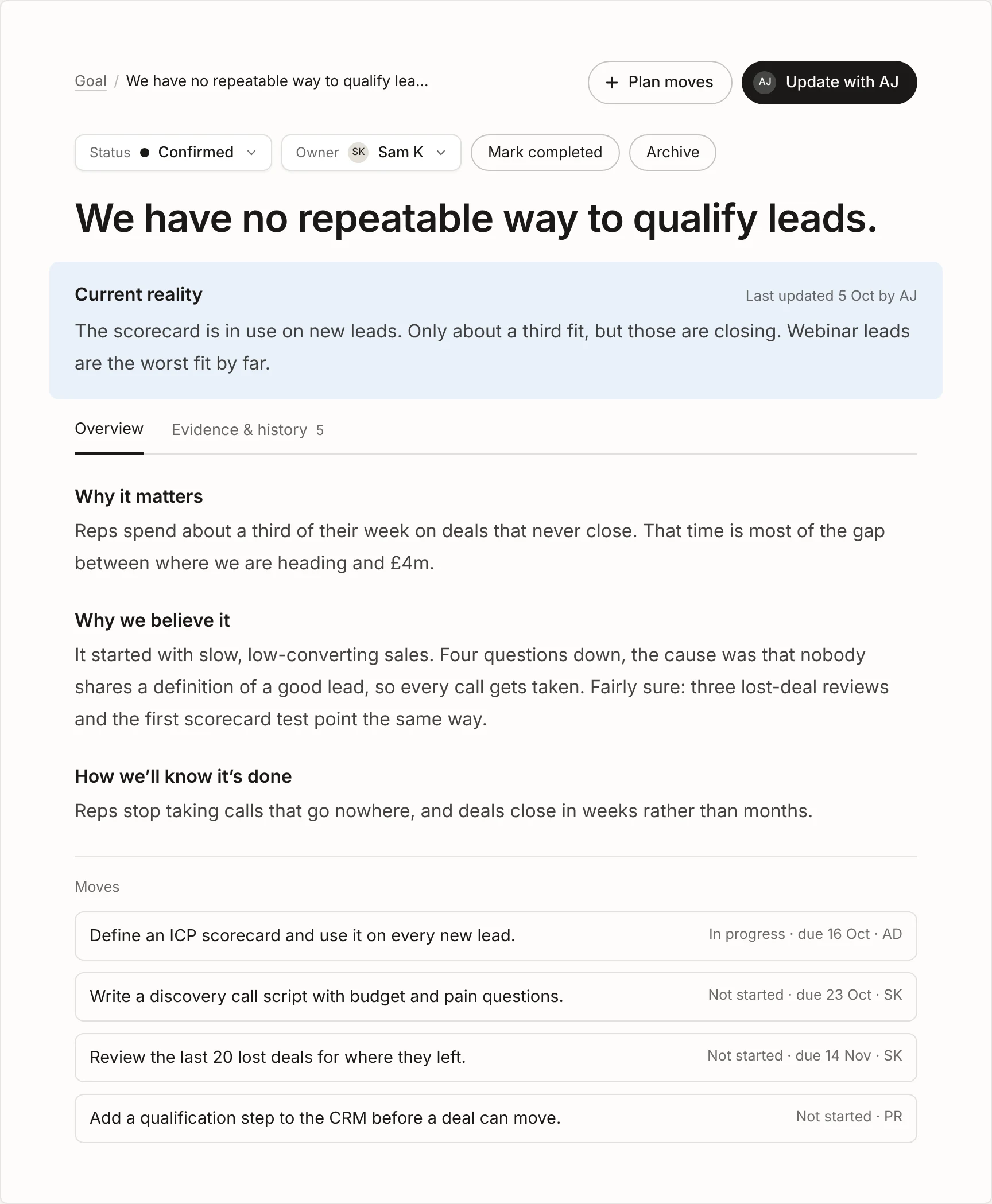
The moves, each with an owner.
Every move has a status, a due date and one person. They update AJ in a sentence when it moves.
-
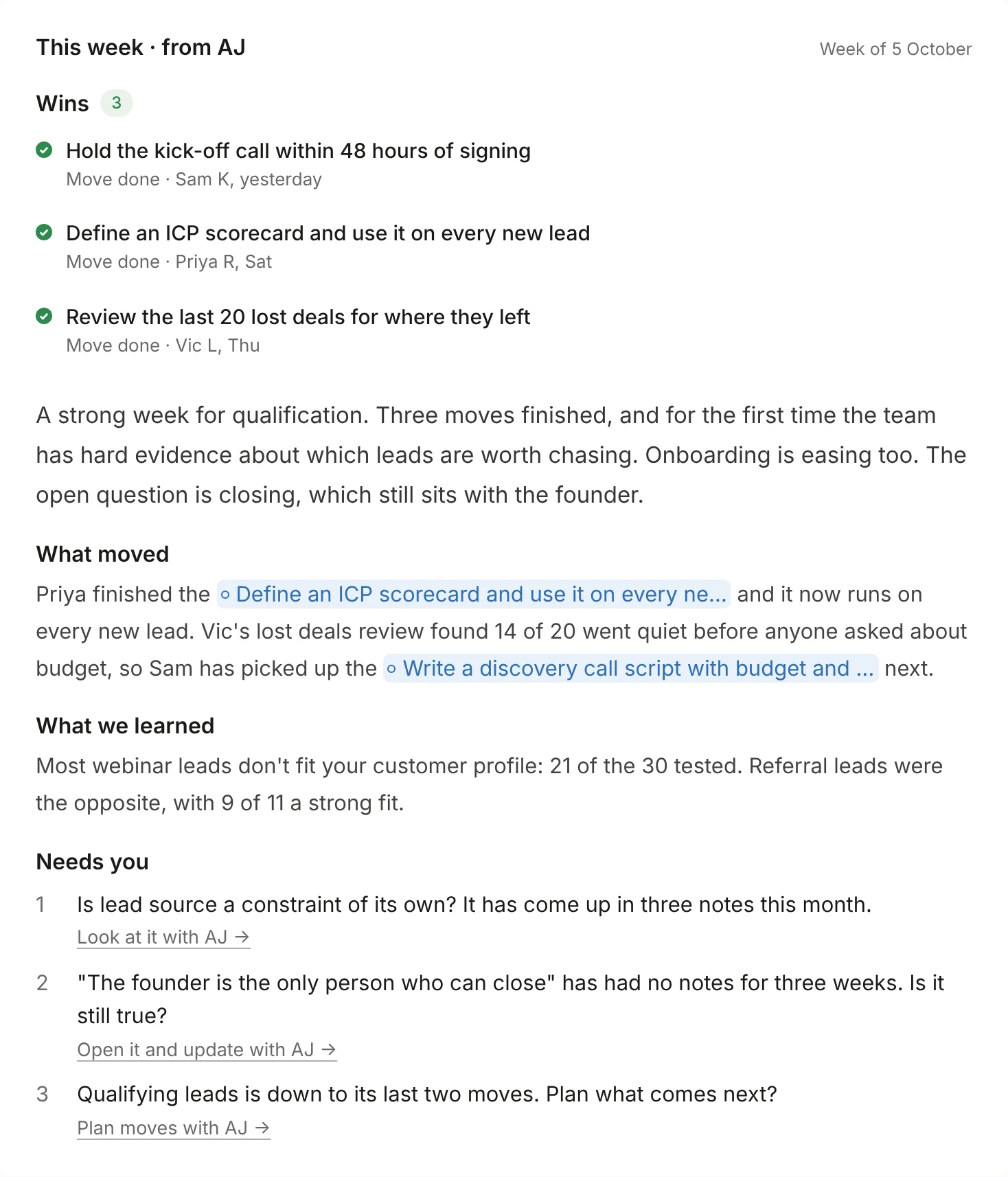
This week from AJ.
The wins, how it’s going and up to three things that need a decision, ready every Monday.
Raise while you keep the business growing.
A fundraise only works if the business keeps moving during it. Investors will ask what happened since the first meeting, so the company still needs to grow revenue, land the go-to-market or ship the launch the round is based on. A raise is also usually the start of scaling the company.
In Clearahead the round has its own workspace next to the company’s main goal. On the free plan you have one workspace, which many early teams use for the company goal. On the Clearahead plan you can run up to 10, so the round, the growth goal and the launch each get their own constraints and owners. People and billing are shared, and each person’s summary email covers every workspace they’re in.
Investors you invite as Viewers can see the whole plan and ask AJ questions, without waiting for a deck. That’s a much better answer to “how’s it going?” than a monthly email, and it keeps the conversation going after the round closes. For how AI changes the way companies report progress, read Information is cheap. Decisions aren’t.
- Often run alongside Revenue growth planning Find what’s really capping revenue and get the whole team moving on it.
- Often run alongside Scaling a company Grow from a founding team to a company that runs without the founder in every decision.
- Often run alongside Go-to-market planning Plan and run a go-to-market strategy across sales, marketing and product.
- Often run alongside Product launch planning Bring a new product to market with product, marketing and sales on one plan.
Who does what.
Three roles, enforced by the app. Everyone is included in one price.
-
Founders and CEO
ArchitectSet the round as a goal, agree what investors will push on and make the calls only they can make.
-
COO, finance and heads of department
ContributorOwn the moves that build the evidence and keep the business running, and update AJ in a sentence.
-
Investors, board and advisers
ViewerFollow progress and ask AJ questions, without waiting for the next update email.
One price for every goal you run.
Free
£0
Up to 3 people and one workspace, with full access to AJ. No card needed.
Clearahead plan
£297 a month
Or £2,997 a year. Unlimited people and up to 10 workspaces, one for each goal. No seats to count.
Questions.
What is a fundraising planning tool?
A fundraising planning tool helps a company prepare for and run a funding round. Clearahead treats the round as a goal: it shows what’s standing between you and the raise, the moves to fix it and who owns each one, with AJ keeping it current and writing the weekly picture.
Is this a CRM for investors?
No. Keep your investor pipeline in a spreadsheet or CRM. Clearahead tracks the goal of the round and the work to make the company ready for it.
What can investors see?
Viewers see the whole plan in your organisation and can ask AJ questions, but can’t change anything. Invite investors when you’re happy for them to see every workspace, including the round. Most founders invite existing investors early and new ones once terms are close.
We’re pre-seed. Is it worth it?
Yes, if you’re more than three people. The free plan covers up to three people and one workspace, with full access to AJ and no card. See Clearahead for startups.
Can AJ write our investor update?
This week from AJ gives you the wins, how it’s going and what needs you, every Monday. Most founders use it as the basis of their update and add their own voice.
Can we run this alongside our other goals?
Yes. Each goal gets its own workspace with its own constraints, moves and weekly brief. The free plan has one workspace and the Clearahead plan includes up to 10, with your people and billing shared across them. See every use case.
How much does Clearahead cost?
Free for up to three people and one workspace, with full access to AJ and no card. Then £297 a month or £2,997 a year ($397 or $3,997) for the whole company, with unlimited people and up to 10 workspaces. See pricing.
Still have a question? Get in touch.
More ways teams use Clearahead.
- Profit improvement plan Profit improvement planning
- Acquisition planning tool Acquisition planning
- Market expansion planning tool Market expansion planning
- AI adoption plan AI adoption planning
- Customer retention plan Customer retention planning
All use cases → Who Clearahead is for → Goal tracking software →
Raise the round. Keep the company moving.
Free for up to 3 people. No card needed.