
The acquisition planning tool that keeps the deal on its promise.
Buying a company is the easy part. Making it worth what you paid takes months of work by two teams who have never worked together. Clearahead gives the acquisition one goal, the value the deal is meant to deliver, and an honest list of what could stop it, with an owner on every move. AJ, the AI inside Clearahead, keeps both leadership teams looking at the same picture from the first day.
Free for up to 3 people. No card needed. Or speak to us.
What is acquisition planning?
Acquisition planning covers everything a company does to buy another business and make the deal work: deciding why to acquire, finding and assessing targets, due diligence, agreeing the deal, and then integrating the two companies afterwards. That last part, post-merger integration, is where most of the work and most of the risk sits.
A good acquisition plan starts from the reason for the deal, often called the deal thesis: what the combined business will be able to do that neither could alone. More customers, a product you didn’t have, a team you couldn’t hire, a market you couldn’t reach. Every part of the plan, from the first 100 days to the systems migration, should serve that thesis. When it doesn’t, the integration turns into a long list of tasks and the reason for the deal gets lost.
Why acquisition planning matters, and who owns it.
An acquisition is one of the biggest bets a company makes, and one of the hardest to undo. It uses cash or equity that could have funded something else, takes up the leadership team’s time for months, and changes the lives of everyone in the business being bought. When integration goes well, the combined company moves faster than either did alone. When it doesn’t, you have two cultures, two sets of systems and a goodwill line on the balance sheet.
The CEO usually owns the deal, with a corporate development lead or COO running the process and finance leading diligence. After completion, an integration lead often takes over day to day, but the work belongs to almost every department in both companies: sales teams to combine, products to align, customers to reassure, systems to merge and people to keep.
The single biggest thing an acquiring leadership team can do is keep everyone pointed at the same reason for the deal. When both teams can see the goal, what’s in the way and who owns each move, integration decisions get made on purpose instead of by whoever shouts loudest. That clarity also matters for the people being acquired, who want to know what’s changing and why.
What makes acquisitions hard to get right.
Deals rarely fall apart at signing. They lose their value slowly, in the months afterwards.
-
The thesis gets lost in the checklist.
Integration plans run to hundreds of tasks. The two or three things that will decide whether the deal pays off look just like the rest.
-
Two teams, two pictures.
Each leadership team has its own view of progress. Neither sees the other’s concerns until they come up in a tense meeting.
-
Key people leave.
Uncertainty drives out the people the deal depended on, often before anyone notices they were unhappy.
-
Customers get forgotten.
The integration looks inward at systems and structure while customers of the acquired business quietly shop around.
-
The day job doesn’t stop.
Both companies still have targets to hit. Integration competes with the core business for the same people.
How to plan an acquisition and integration in Clearahead.
Give the acquisition its own workspace and write the deal thesis as the goal. Not “complete the integration”, but something like “Cross-sell our platform to 30% of the acquired customers within 12 months, keeping the acquired team’s key people”. Write why it matters and how you’ll know. That goal is what every integration decision gets checked against.
With AJ, work out what could stop the deal delivering. Before completion that might be gaps in diligence or an unclear plan for the first 100 days. After completion it’s usually things like “Acquired customers don’t know what the deal means for them”, “The two sales teams sell against each other” or “Key engineers haven’t been told what their role will be”. AJ asks the questions an experienced integration lead would, and helps you put the constraints in order. Keep the detailed integration checklist in your project tool; Clearahead tracks the constraints that checklist is meant to clear.
Bring people from both companies into the workspace with the right roles. Owners update AJ in a sentence, and AJ keeps the facts as evidence, so you build a record of what was decided and why. Every Monday, This week from AJ gives both leadership teams the same view of progress and the calls that need them. Before a deal is public, run the planning in a separate organisation for the deal team. One login can belong to several, so nobody needs a second account, and the integration workspace can start in the main organisation once the deal is announced.
- 01
Write the deal thesis as the goal.
Talk AJ through why you’re buying and what the combined business should achieve. Make it measurable.
- 02
Find what could stop it.
AJ helps you find the constraints on the deal’s value, from people to customers to systems, in order.
- 03
Own it across both teams.
Leaders from each company own moves. Everyone sees the same goal and the same progress.
- 04
Track value, not just tasks.
AJ’s Monday brief shows whether the deal is delivering and what needs a decision, every week.
- Acquired customers don’t know what the deal means for them
- The two sales teams sell against each other
- Key engineers haven’t been told what their role will be
- Call the top 20 acquired customers in the first fortnight
- Write one plain letter to every customer on what changes and what doesn’t
- Give account managers a short answer sheet for the questions customers ask
An illustration, not a customer story.
What it looks like in Clearahead.
Real screens from the app. AJ keeps them up to date as your team works.
-
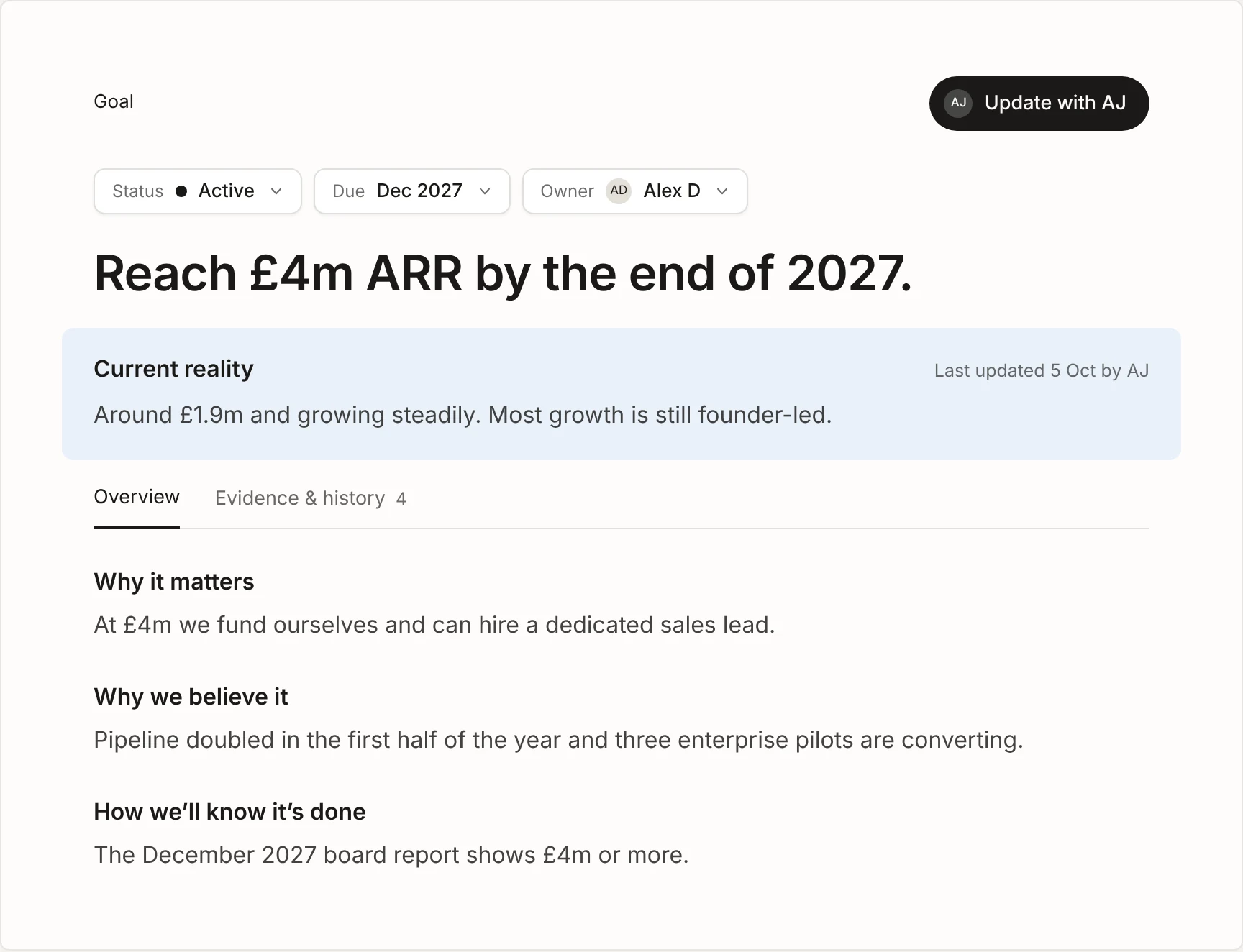
The goal, on one page.
What you’re aiming for, why it matters, how you’ll know it’s done and where it stands today, in your team’s words.
-
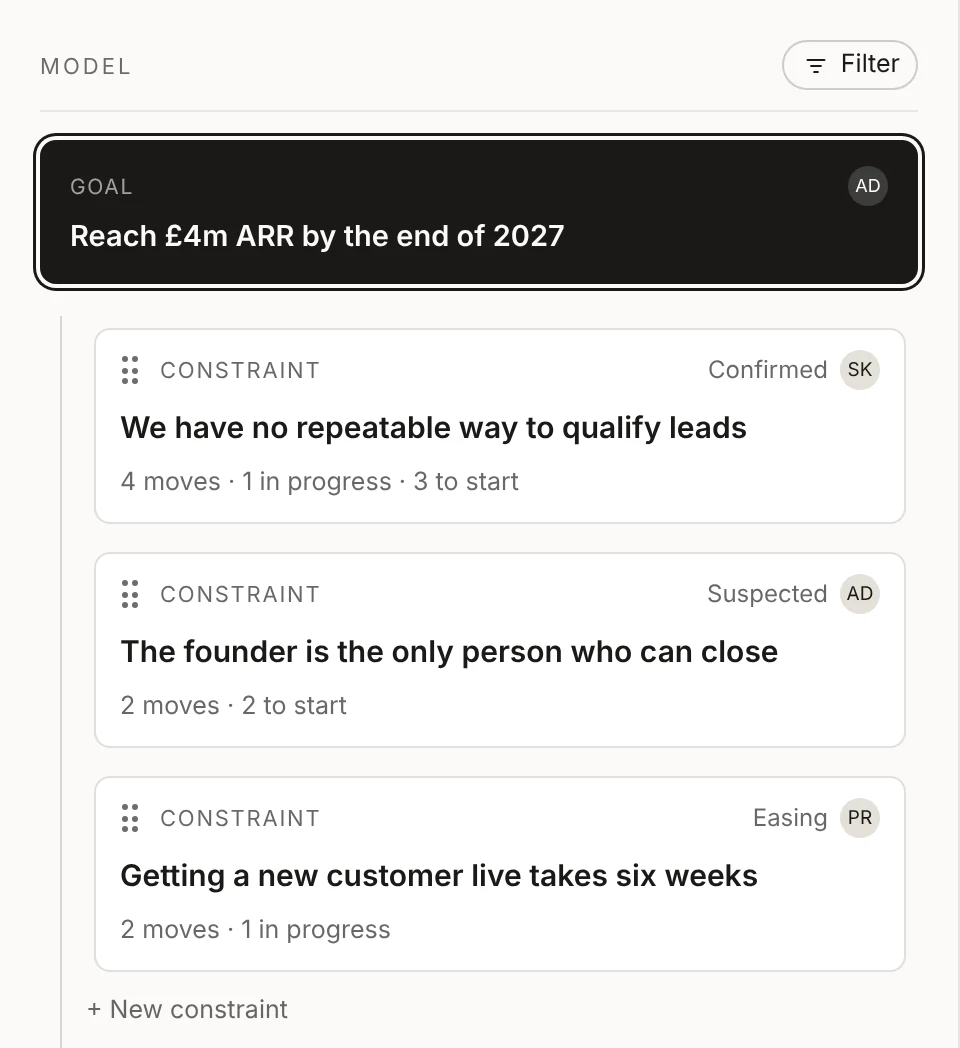
What’s holding it back, in order.
The few constraints really in the way, each with an owner and a status. Your team decides the order.
-
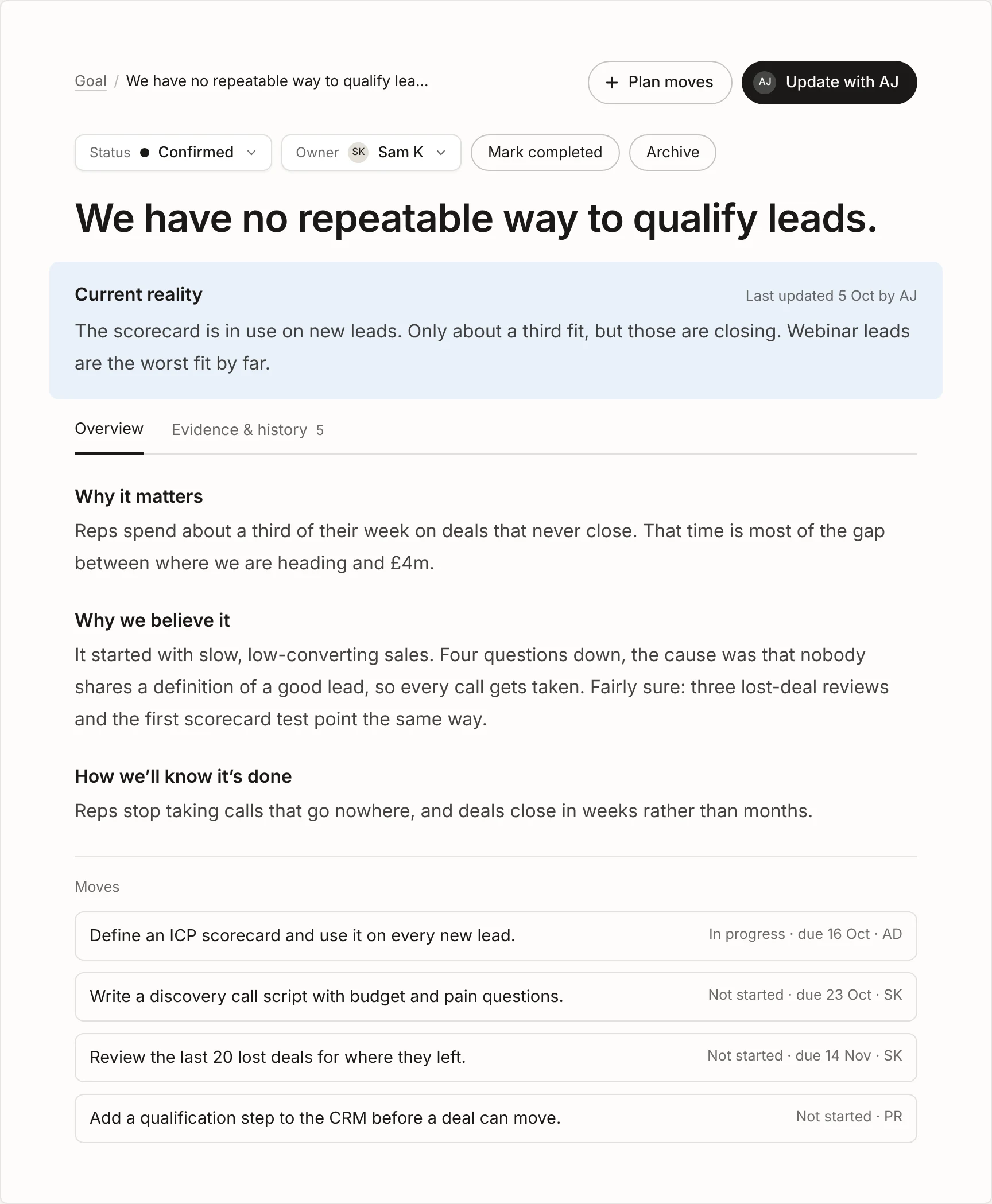
The moves, each with an owner.
Every move has a status, a due date and one person. They update AJ in a sentence when it moves.
-
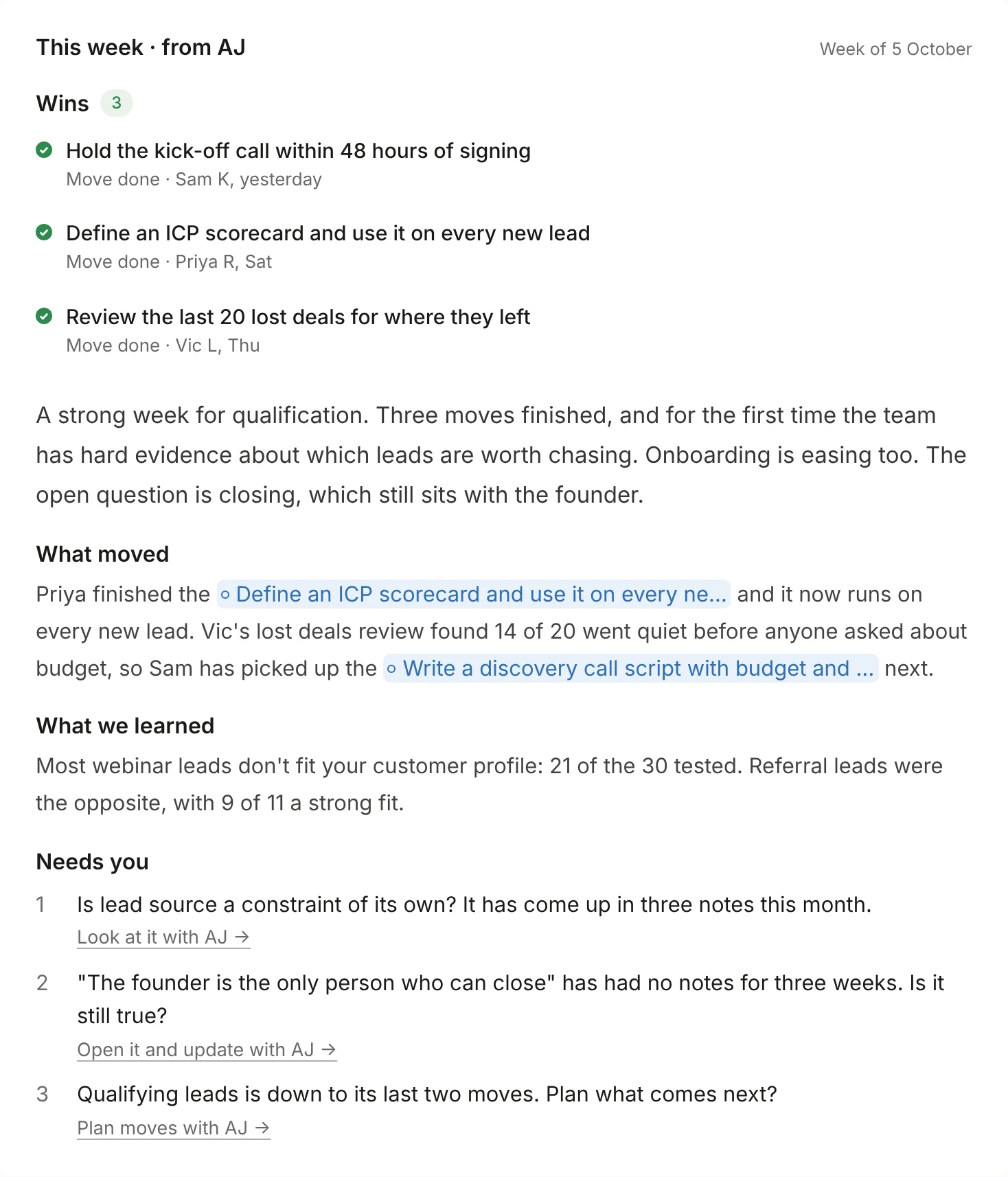
This week from AJ.
The wins, how it’s going and up to three things that need a decision, ready every Monday.
Integrate while the core business keeps growing.
An acquisition always runs next to the day job. The acquiring company still has to hit its revenue goal, and the acquired business has customers to keep. Often the deal is part of a bigger plan to scale the company or enter a new market, and sometimes it’s paired with a push on margins to make the combined numbers work.
In Clearahead the integration gets its own workspace alongside the company’s other goals, up to 10 on the Clearahead plan. People and billing are shared, so a sales director can own moves in the integration and the revenue workspace and see both in My work. The leadership team can see where integration work is pulling people away from the core business, and make that trade-off deliberately.
Advisers often work across several deals. One Clearahead login can belong to several organisations, so a corporate development adviser can follow each client’s integration without separate accounts. See Clearahead for advisers.
- Often run alongside Scaling a company Grow from a founding team to a company that runs without the founder in every decision.
- Often run alongside Revenue growth planning Find what’s really capping revenue and get the whole team moving on it.
- Often run alongside Profit improvement planning Raise margins and profit without losing the momentum that got you here.
- Often run alongside Customer retention planning Find why customers leave and get every team working on keeping them.
Who does what.
Three roles, enforced by the app. Everyone is included in one price.
-
CEO, COO or integration lead
ArchitectSets the deal goal, agrees what could stop it and makes the calls AJ says need them.
-
Leaders from both companies
ContributorOwn the moves for their part of the integration and update AJ in a sentence.
-
Board, investors and deal advisers
ViewerFollow whether the deal is delivering and ask AJ questions between board meetings.
One price for every goal you run.
Free
£0
Up to 3 people and one workspace, with full access to AJ. No card needed.
Clearahead plan
£297 a month
Or £2,997 a year. Unlimited people and up to 10 workspaces, one for each goal. No seats to count.
Questions.
What is an acquisition planning tool?
An acquisition planning tool helps a company plan a deal and run the integration afterwards. Clearahead focuses on the deal’s goal, the constraints that could stop it delivering and who owns each move, kept current by AJ from short updates.
Is this a data room or diligence tool?
No. Keep diligence documents in your data room and the detailed integration checklist in your project tool. Clearahead tracks the goal of the deal and the constraints in the way of it.
Can we keep the acquisition plan confidential?
Yes. Everyone in an organisation can see all its workspaces, so set up a separate organisation for the deal team while the deal is private. One login can belong to several organisations. Once the deal is announced, run the integration in your main organisation.
Can people from the acquired company join?
Yes. Invite them into the organisation as Contributors or Viewers. On the Clearahead plan there’s no charge per person, so both teams can work in the same place.
Do you mean customer acquisition?
This page is about buying a company. For winning customers, see go-to-market planning and revenue growth planning.
Can we run this alongside our other goals?
Yes. Each goal gets its own workspace with its own constraints, moves and weekly brief. The free plan has one workspace and the Clearahead plan includes up to 10, with your people and billing shared across them. See every use case.
How much does Clearahead cost?
Free for up to three people and one workspace, with full access to AJ and no card. Then £297 a month or £2,997 a year ($397 or $3,997) for the whole company, with unlimited people and up to 10 workspaces. See pricing.
Still have a question? Get in touch.
More ways teams use Clearahead.
- GTM planning tool Go-to-market planning
- Product launch planning tool Product launch planning
- Fundraising planning tool Fundraising planning
- Market expansion planning tool Market expansion planning
- AI adoption plan AI adoption planning
All use cases → Who Clearahead is for → Goal tracking software →
Make the deal worth what you paid.
Free for up to 3 people. No card needed.